AI Automation for SMBs: 15% Efficiency Boost in 3 Months

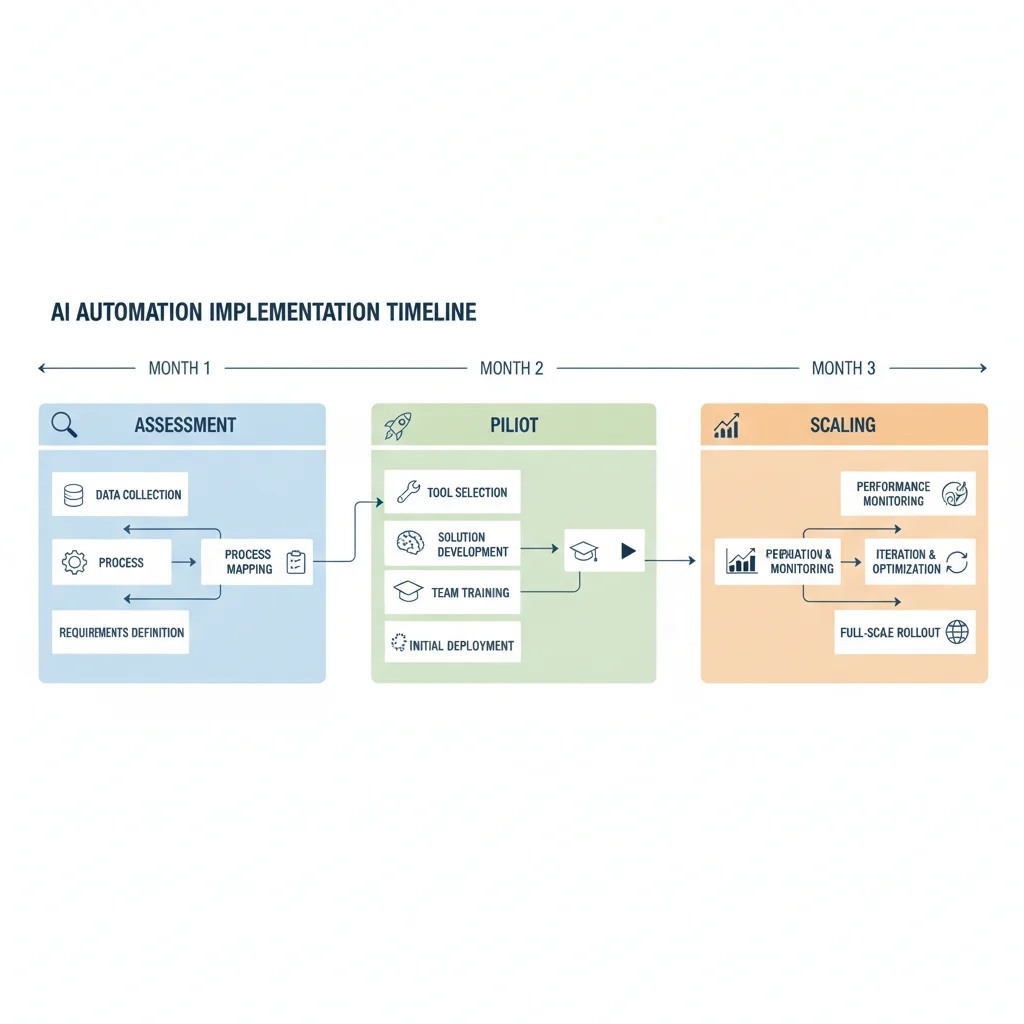
In today’s fast-paced business landscape, small and medium-sized businesses (SMBs) across the United States are constantly seeking innovative ways to gain a competitive edge. The promise of artificial intelligence (AI) and automation is no longer a futuristic dream but a tangible reality that can revolutionize operations. This comprehensive guide outlines a strategic, 3-month implementation plan designed to help US SMBs achieve a remarkable 15% boost in operational efficiency through AI-powered automation. By focusing on practical steps, clear objectives, and measurable outcomes, we’ll navigate the journey from initial assessment to widespread adoption, ensuring your investment yields significant returns.
The Imperative of AI Automation for US SMBs
For US SMBs, operational efficiency isn’t just about cutting costs; it’s about optimizing resource allocation, enhancing customer satisfaction, and freeing up valuable human capital to focus on strategic initiatives. In an era where larger enterprises leverage advanced technologies, SMBs must adapt or risk being left behind. AI automation offers a powerful solution, capable of streamlining repetitive tasks, improving data analysis, and enabling more informed decision-making.
Why a 15% Efficiency Boost Matters
A 15% boost in operational efficiency might seem ambitious, but it’s an achievable and transformative goal. For many SMBs, this translates directly into significant cost savings, increased output, and improved service delivery. Imagine reducing the time spent on administrative tasks, accelerating customer support responses, or optimizing inventory management. These improvements directly impact your bottom line and enhance your market position. This guide focuses on actionable strategies to make this 15% efficiency gain a reality for your business, specifically through targeted AI automation SMB initiatives.
Common Misconceptions About AI for SMBs
Many SMBs shy away from AI, believing it’s too complex, too expensive, or only suitable for tech giants. This couldn’t be further from the truth. The market is now abundant with user-friendly, scalable, and affordable AI tools designed specifically for smaller businesses. The key is to approach AI adoption strategically, identifying specific pain points where AI can deliver the most immediate and impactful results. Our 3-month plan is designed to demystify this process and make AI automation accessible.
Month 1: Foundation and Pilot – Identifying Opportunities and Setting the Stage
The first month of your AI automation journey is crucial for laying a solid foundation. This phase involves a thorough assessment of your current operations, identifying key areas ripe for automation, selecting the right tools, and initiating a small-scale pilot project. The goal here is to understand your unique needs and prove the concept of AI automation within your specific business context.
Step 1: Comprehensive Operational Assessment (Weeks 1-2)
Before you can automate, you need to understand what needs automating. This step involves a deep dive into your existing workflows and processes. Gather your team and ask critical questions:
- What tasks are repetitive and time-consuming? Think about data entry, report generation, email management, customer inquiries, or scheduling.
- Where do bottlenecks frequently occur? Identify points in your workflow where progress often slows down or stops.
- Which processes are prone to human error? Manual tasks often lead to mistakes that AI can significantly reduce.
- Where is valuable employee time being diverted from core responsibilities? Freeing up employees to focus on higher-value tasks is a primary benefit of AI automation for SMBs.
Document these processes meticulously. Create flowcharts or diagrams to visualize each step. This initial assessment will help you pinpoint specific areas where AI automation can deliver the most significant impact on operational efficiency. Focus on tasks that are rule-based, high-volume, and have clear inputs and outputs.
Step 2: Define Key Performance Indicators (KPIs) and Set Baselines (Week 2)
To measure your 15% efficiency boost, you need to know where you’re starting from. For each identified area of potential automation, establish clear, measurable KPIs. Examples include:
- Average time to process an invoice.
- Number of customer support tickets resolved per day.
- Time spent on manual data entry.
- Accuracy rate of inventory counts.
- Employee hours spent on administrative tasks.
Collect baseline data for these KPIs. This data will be essential for tracking progress and demonstrating the ROI of your AI automation efforts. Without clear baselines, it will be impossible to quantify the 15% improvement.
Step 3: Research and Select AI Tools (Weeks 2-3)
The market for AI tools is vast. Focus your research on solutions that directly address the pain points identified in your assessment. Consider:
- Robotic Process Automation (RPA): Ideal for automating repetitive, rule-based digital tasks.
- AI-powered chatbots/virtual assistants: For customer service, internal support, or lead qualification.
- Intelligent Document Processing (IDP): To extract data from unstructured documents like invoices or forms.
- Predictive analytics: For inventory management, sales forecasting, or customer behavior analysis.
- AI-driven marketing automation: Personalizing customer outreach and optimizing campaigns.
When selecting tools, prioritize those that are:
- User-friendly: Easy for your team to learn and operate.
- Scalable: Can grow with your business.
- Integrable: Can connect with your existing software (CRM, ERP, accounting software).
- Cost-effective: Fit within your budget while delivering clear value.
- Supported: Offer good customer support and resources.
Don’t be afraid to try free trials or demo versions to test functionality before committing to a solution. This is a critical step in ensuring your AI automation SMB strategy is built on the right technology.
Step 4: Pilot Project Implementation (Weeks 3-4)
Start small. Choose one or two high-impact, low-complexity processes for your initial pilot project. This allows you to test the chosen AI tools, identify potential challenges, and refine your implementation strategy without disrupting your entire operation. A good pilot project should:
- Have clearly defined boundaries.
- Involve a small, dedicated team.
- Have measurable outcomes directly linked to your KPIs.
- Be completed within a short timeframe (e.g., 2-3 weeks).
For example, if you identified manual invoice processing as a bottleneck, your pilot could involve automating the data extraction from a specific set of invoices using an IDP tool. Monitor the pilot closely, gather feedback from the team, and document lessons learned. This iterative approach is key to successful AI automation.
Month 2: Expansion and Optimization – Scaling Up and Refining Processes
Having successfully completed a pilot, Month 2 focuses on expanding your AI automation efforts to more areas of your business and optimizing the performance of your initial implementations. This phase is about building momentum and demonstrating broader value.
Step 5: Analyze Pilot Results and Refine (Week 5)
Review the data and feedback from your pilot project. Did you achieve the expected efficiency gains? What challenges arose? What worked well?
- Compare post-pilot KPIs with your baselines. Quantify the improvements.
- Gather detailed feedback from the team members involved.
- Identify any adjustments needed for the AI tools, workflows, or training.
- Document best practices and lessons learned for future implementations.
This critical analysis ensures that you learn from your initial experience and apply those insights to subsequent automation projects. The goal is continuous improvement in your AI automation SMB strategy.
Step 6: Expand Automation to Additional Processes (Weeks 6-8)
Based on your successful pilot and refined strategy, begin automating additional processes. Prioritize those that offer the next highest impact and are similar in complexity to your pilot, gradually tackling more complex automations. Consider areas such as:
- Customer support: Implementing chatbots for FAQs or routing inquiries.
- Marketing: Automating email campaigns or social media scheduling.
- HR: Streamlining onboarding paperwork or applicant screening.
- Sales: Automating lead qualification or CRM data entry.
As you expand, maintain a phased approach. Implement one or two new automations at a time, allowing your team to adapt and providing opportunities for fine-tuning. Ensure proper training for all affected employees.
Step 7: Integrate AI with Existing Systems (Weeks 7-8)
For maximum efficiency, your AI tools should seamlessly integrate with your existing software ecosystem. This could mean connecting your RPA tool to your ERP, your chatbot to your CRM, or your analytics platform to your sales data. Seamless integration eliminates data silos, reduces manual data transfer, and ensures a unified view of your operations. Work closely with your IT team or software vendors to ensure smooth integration, which is paramount for successful AI automation for SMBs.
Step 8: Monitor Performance and Optimize (Weeks 5-8, Ongoing)
Continuous monitoring is essential. Track the KPIs for all automated processes regularly. Look for:
- Efficiency gains: Are tasks being completed faster?
- Accuracy improvements: Are errors reduced?
- Cost savings: Are you spending less on manual labor?
- Employee satisfaction: Are employees happier with less repetitive work?
Use this data to identify areas for further optimization. Perhaps an AI rule needs adjustment, or an integration can be improved. AI models often perform better with more data, so continue to feed them relevant information to enhance their accuracy and effectiveness. This iterative process of monitoring and optimization is key to achieving and sustaining your 15% efficiency boost.
Month 3: Scaling and Sustaining – Maximizing Impact and Future-Proofing
By Month 3, your business should be experiencing tangible benefits from AI automation. This final phase focuses on scaling these successes across the organization, embedding AI into your company culture, and planning for long-term growth and continuous improvement.
Step 9: Widespread Adoption and Training (Weeks 9-10)
With proven success in pilot and expanded projects, it’s time to roll out AI automation more broadly. This requires comprehensive training for all employees who will interact with or be affected by the new automated processes. Training should cover:
- How to use the new AI tools.
- Understanding the benefits of automation for their roles and the company.
- How to resolve common issues or escalate problems.
- The importance of data quality for AI performance.
Foster a culture of collaboration and emphasize that AI is a tool to empower employees, not replace them. Highlight how AI automation for SMBs creates opportunities for employees to engage in more strategic and fulfilling work. Establish internal champions who can support their colleagues and advocate for the benefits of AI.
Step 10: Measure Overall Efficiency Boost (Week 11)
At the end of the third month, conduct a comprehensive review of all implemented AI automation initiatives. Aggregate the data from all your KPIs. This is where you calculate your overall operational efficiency boost. Compare your current performance against the baselines established in Month 1. Have you reached or exceeded the 15% target? Celebrate your successes and analyze any areas that fell short of expectations.
Don’t just look at quantitative data; gather qualitative feedback from employees and customers. Are internal processes smoother? Is customer satisfaction improving due to faster responses or more accurate service? This holistic view provides a complete picture of your AI automation’s impact.
Step 11: Establish Governance and Best Practices (Week 12)
To sustain the benefits of AI automation, establish clear governance policies and best practices. This includes:
- Data governance: Ensuring data quality, privacy, and security, which are crucial for AI performance.
- Process documentation: Keeping detailed records of automated workflows and their configurations.
- Change management: A framework for introducing new automations or modifying existing ones.
- Regular audits: Periodically reviewing automated processes for effectiveness and compliance.
- Feedback loops: Creating channels for employees to suggest improvements or report issues.
These practices ensure that your AI automation efforts remain robust, adaptable, and aligned with your business objectives. They are fundamental to the long-term success of AI automation for SMBs.
Step 12: Plan for Continuous Improvement and Future AI Opportunities (Ongoing)
AI automation is not a one-time project but an ongoing journey. As your business evolves and new AI technologies emerge, continue to seek out new opportunities for automation. Stay informed about industry trends, attend webinars, and engage with AI communities. Regularly revisit your operational assessment to identify new pain points that AI can address.
Consider advanced AI applications as your business matures, such as:
- Machine learning for predictive maintenance: In manufacturing or logistics.
- Natural Language Processing (NLP) for advanced customer insights: Analyzing customer feedback at scale.
- Computer vision for quality control: In production or inventory.
By fostering a culture of innovation and continuous improvement, your US SMB can not only sustain its 15% efficiency boost but also achieve even greater levels of operational excellence.

Overcoming Common Challenges in AI Automation for SMBs
While the benefits are clear, implementing AI automation can present challenges. Being aware of these and preparing for them can smooth your journey.
Data Quality and Availability
AI thrives on data. Poor data quality (inaccurate, incomplete, or inconsistent data) can severely hamper the performance of AI models. Before embarking on automation, ensure your data is clean, organized, and accessible. Invest time in data hygiene and establish clear data input protocols.
Resistance to Change
Employees may feel threatened by automation, fearing job displacement. Address these concerns head-on through transparent communication, emphasizing that AI is a tool to augment human capabilities, not replace them. Highlight how AI automation frees them from mundane tasks, allowing them to focus on more creative, strategic, and rewarding work. Involve employees in the process from the beginning to foster a sense of ownership and collaboration.
Lack of Technical Expertise
US SMBs may not have in-house AI specialists. This is where choosing user-friendly, low-code/no-code AI solutions becomes critical. Many vendors offer extensive support, tutorials, and managed services. Consider partnering with an AI consultant for initial setup and guidance, especially for more complex integrations. Focus on training existing staff to become ‘citizen developers’ or power users of the chosen AI tools.
Budget Constraints
While AI tools are becoming more affordable, budget remains a consideration for SMBs. Start with pilot projects that offer a clear and quick ROI. This allows you to demonstrate value and secure further investment. Look for subscription-based models that offer flexibility and avoid large upfront costs. The 15% efficiency boost will quickly justify the investment.
Vendor Lock-in
Be mindful of vendor lock-in when selecting AI tools. Choose solutions that offer open APIs and good integration capabilities, allowing you to switch or integrate with other tools in the future if needed. Flexibility is key to a sustainable AI automation strategy.
The Future is Now: Empowering Your US SMB with AI Automation
Achieving a 15% boost in operational efficiency with AI-powered automation within a 3-month timeframe is an ambitious yet entirely attainable goal for US SMBs. By following this structured guide, your business can systematically identify automation opportunities, implement targeted AI solutions, and continuously optimize processes for sustained growth and profitability.
The journey of AI automation for SMBs is about more than just technology; it’s about transforming how your business operates, empowering your employees, and ultimately delivering greater value to your customers. Embrace this transformation, and position your SMB at the forefront of innovation. The time to act is now, and the rewards of a more efficient, agile, and competitive business await.
Key Takeaways for Your AI Automation Journey:
- Start Small, Think Big: Begin with high-impact, low-complexity pilot projects to build confidence and gather insights.
- Data is King: Prioritize data quality and accessibility to fuel effective AI.
- People First: Address employee concerns, provide comprehensive training, and foster a culture of collaboration.
- Measure Everything: Establish clear KPIs and continuously monitor performance to quantify your efficiency gains.
- Iterate and Optimize: AI implementation is an ongoing process of refinement and improvement.
- Strategic Tool Selection: Choose user-friendly, scalable, and integrable AI solutions that fit your budget and needs.
By committing to this 3-month plan, your US SMB can not only achieve a significant 15% increase in operational efficiency but also lay the groundwork for long-term digital transformation and sustained success in the evolving market.