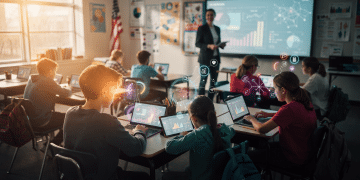
AI-Driven Education: Personalizing Learning for US Students

AI-Driven Education is revolutionizing learning experiences for students in the US by offering personalized pathways, adaptive assessments, and AI tutors that cater to individual needs and learning styles, promising more effective and engaging education.
The landscape of education in the United States is rapidly evolving, and at the forefront of this transformation is AI-Driven Education: Personalizing Learning Experiences for US Students – New Developments. This innovative approach leverages the power of artificial intelligence to tailor learning to the unique needs and abilities of each student, promising to revolutionize the way we educate future generations.
The Rise of AI in US Education
Artificial intelligence is no longer a futuristic concept; it’s an increasingly integral part of our daily lives, and education is no exception. The integration of AI in US classrooms is driven by the potential to enhance learning outcomes and address persistent challenges in the education system.
What is AI-Driven Education?
AI-Driven Education utilizes artificial intelligence technologies to create personalized learning experiences. This means adapting the pace, content, and method of instruction to suit individual student needs, rather than relying on a one-size-fits-all approach.
Key Benefits of AI in Education
The benefits of AI in education are numerous, ranging from personalized learning paths to automated administrative tasks. These advancements are not just about technology; they’re about creating a more effective and equitable learning environment for all students.
- Personalized Learning: Tailoring content to individual student needs.
- Automated Assessment: Providing immediate feedback and grading.
- Intelligent Tutoring Systems: Offering 24/7 learning support.
- Data-Driven Insights: Helping educators understand student performance better.
In essence, AI is helping to make education more efficient, effective, and engaging, paving the way for a brighter future for US students.
New AI Developments Shaping Education
Recent advancements in AI are significantly shaping the way education is delivered and received in the US. These developments are not only improving learning outcomes but also making education more accessible and equitable.

Adaptive Learning Platforms
Adaptive learning platforms use AI algorithms to adjust the difficulty level and content based on a student’s performance. This ensures that students are always challenged appropriately and receive targeted support where they need it most.
AI-Powered Assessment Tools
AI-powered assessment tools can automatically grade assignments, provide detailed feedback, and identify areas where students are struggling. This frees up teachers’ time and allows them to focus on providing personalized instruction.
- Real-time feedback on assignments
- Automated grading to save time
- Identification of learning gaps
- Personalized recommendations for improvement
These advancements are empowering both students and educators, creating a more dynamic and responsive learning environment.
Personalized Learning Paths with AI
One of the most significant impacts of AI in education is the ability to create personalized learning paths for each student. This approach recognizes that every student learns differently and at their own pace.
Understanding Individual Learning Styles
AI algorithms can analyze a student’s performance, learning preferences, and strengths to identify their individual learning style. This information is then used to create a customized learning plan.
Customized Content Delivery
AI systems can deliver content in a variety of formats, such as videos, interactive simulations, and gamified exercises, to cater to different learning styles and preferences.
- Videos for visual learners
- Interactive simulations for kinesthetic learners
- Gamified exercises for engaging learning
- Text-based content for auditory learners
By tailoring the learning experience to each student’s unique needs, AI is helping to unlock their full potential and foster a love of learning.

The Role of AI Tutors in Education
AI tutors are becoming increasingly common in US schools, providing students with 24/7 access to personalized learning support. These virtual tutors can answer questions, provide feedback, and guide students through challenging concepts.
Benefits of AI Tutoring Systems
AI tutoring systems offer several key benefits, including personalized instruction, immediate feedback, and the ability to learn at one’s own pace. This can be especially helpful for students who need extra support or who are struggling with specific topics.
Examples of AI Tutors in Action
AI tutors are being used in a variety of subjects, from math and science to language arts and history. They can provide individualized instruction and support, helping students to master key concepts and improve their grades.
- Math tutors that adapt to skill level
- Science tutors that simulate experiments
- Language arts tutors that provide writing feedback
- History tutors that offer interactive timelines
AI tutors are revolutionizing the way students learn, providing personalized support and guidance that can help them achieve their academic goals.
Addressing Challenges and Concerns
While AI-Driven Education offers numerous benefits, it also presents several challenges and concerns that need to be addressed. These include data privacy, algorithmic bias, and the potential for job displacement.
Data Privacy and Security
Protecting student data is paramount. Schools and educational institutions must implement robust security measures to safeguard sensitive information and comply with data privacy regulations.
Algorithmic Bias
AI algorithms are only as good as the data they are trained on. If the data is biased, the algorithm will be biased as well. It’s crucial to ensure that AI systems are fair and equitable for all students.
- Regularly audit AI algorithms for bias
- Use diverse and representative data sets
- Provide transparency about how AI systems work
- Offer recourse mechanisms for students who are unfairly impacted
By addressing these challenges, we can ensure that AI is used responsibly and ethically in education, maximizing its benefits while minimizing potential risks.
The Future of AI-Driven Education in the US
The future of AI-Driven Education in the US is bright, with the potential to transform the way we learn and teach. As AI technology continues to evolve, we can expect even more personalized, adaptive, and engaging learning experiences for students.
Emerging Trends in AI and Education
Several emerging trends are poised to shape the future of AI and education, including the use of virtual reality and augmented reality, the development of more sophisticated AI tutors, and the integration of AI into lifelong learning programs.
Preparing Students for an AI-Driven World
As AI becomes increasingly prevalent in the workforce, it’s essential to prepare students with the skills and knowledge they need to succeed in an AI-driven world. This means teaching them critical thinking, problem-solving, and creativity, as well as providing them with opportunities to work with AI tools and technologies.
- Integrating AI into STEM education
- Developing AI literacy programs
- Promoting critical thinking and problem-solving skills
- Encouraging creativity and innovation
By embracing AI and preparing students for its future impact, we can ensure that they are well-equipped to thrive in the 21st century.
| Key Point | Brief Description |
|---|---|
| 💡 Personalized Learning | AI adapts content to individual needs. |
| 🤖 AI Tutors | 24/7 support and guidance. |
| 📊 Data Insights | Better understanding of student performance. |
| 🛡️ Privacy Concerns | Addressing data protection and security. |
FAQ
▼
AI-driven education uses artificial intelligence to personalize learning experiences for students, adapting to their unique needs and pace.
▼
AI analyzes student performance and preferences to deliver customized content, pace, and methods, ensuring optimal engagement and understanding.
▼
AI tutors offer 24/7 personalized support, immediate feedback, and guidance, helping students master concepts and improve grades at their own pace.
▼
Key concerns include data privacy, algorithmic bias, and ensuring fair and equitable access to AI-driven educational resources for all students.
▼
Schools can audit AI algorithms for bias, use diverse data sets, provide transparency about AI systems, and offer recourse mechanisms for students unfairly impacted.
Conclusion
AI-Driven Education: Personalizing Learning Experiences for US Students – New Developments holds immense promise for transforming education in the United States. By embracing these advancements responsibly and addressing potential challenges proactively, we can create a more effective, equitable, and engaging learning environment for all students, preparing them for a future where AI is an integral part of our lives.