AI in Autonomous Vehicles: US Market Trends & Future 2025

AI in Autonomous Vehicles: The Latest Developments and Future Trends in the US Market in 2025 show a significant transformation in transportation, driven by innovations in machine learning, sensor technology, and regulatory frameworks, paving the way for safer and more efficient autonomous systems.
The automotive industry is undergoing a seismic shift, and at the heart of this transformation lies AI in Autonomous Vehicles: The Latest Developments and Future Trends in the US Market in 2025. This article delves into the cutting-edge advancements, emerging trends, and pivotal factors shaping the future of self-driving cars in the United States. As we approach 2025, understanding these dynamics is crucial for anyone involved in the automotive sector, technology development, or policy-making.
The Rise of AI in Autonomous Vehicles
Artificial intelligence (AI) is rapidly transforming the automotive landscape, particularly in the realm of autonomous vehicles. The integration of AI technologies is enabling vehicles to perceive their surroundings, make informed decisions, and navigate without human intervention.
Key AI Technologies Driving Autonomous Vehicles
Several AI technologies are pivotal in the development of autonomous vehicles. These include machine learning, computer vision, and natural language processing. Each plays a crucial role in enabling autonomous vehicles to operate safely and efficiently.
- Machine Learning: Allows vehicles to learn from vast amounts of data, improving decision-making and adaptability over time.
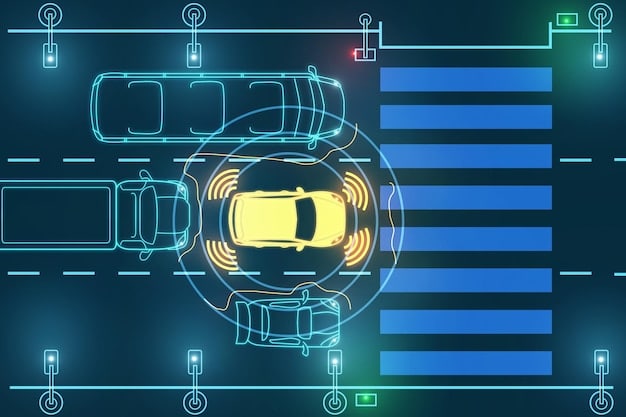
- Computer Vision: Enables vehicles to interpret visual data from cameras and sensors, identifying objects, lanes, and traffic signals.
- Natural Language Processing: Facilitates communication between the vehicle and passengers, allowing for voice-activated controls and personalized experiences.
The convergence of these AI technologies is creating opportunities for safer, more efficient, and user-friendly autonomous vehicles. As AI algorithms become more sophisticated, the capabilities of self-driving cars are expected to expand significantly.
Current State of Autonomous Vehicle Development in the US
The United States is at the forefront of autonomous vehicle development, with numerous companies investing heavily in research, testing, and deployment. While fully autonomous vehicles are not yet commonplace, significant progress is being made across various states.
Leading Companies in Autonomous Vehicle Technology
Several companies are leading the charge in autonomous vehicle technology, each with unique approaches and strengths. These include established automakers, technology giants, and specialized startups.
Companies like Google’s Waymo, Tesla, General Motors’ Cruise, and Ford are heavily invested in advancing self-driving technology. Simultaneously, startups like Aurora and Argo AI are making significant contributions to the field. These companies are actively testing their technologies in controlled environments and public roads across various states, including California, Arizona, and Texas.
The current state of autonomous vehicle development in the US is characterized by progress, innovation, and competition. As these companies continue to refine their technologies and navigate regulatory challenges, the deployment of fully autonomous vehicles seems increasingly imminent.
The involvement of these companies underscores the immense potential and strategic importance of autonomous vehicle technology. Their continuous efforts are driving technological advancements and shaping the future of transportation.
Regulatory Landscape and Policy Challenges
The regulatory landscape surrounding autonomous vehicles is complex and evolving. Federal and state governments are grappling with how to regulate this emerging technology while ensuring public safety and fostering innovation.
Federal vs. State Regulations
There is an ongoing debate about the appropriate level of government oversight for autonomous vehicles. While the federal government has issued voluntary guidelines, most regulatory authority resides at the state level. This has led to a patchwork of regulations across the US, creating challenges for companies seeking to deploy autonomous vehicles nationwide.
Some states are actively encouraging autonomous vehicle testing and deployment, while others are taking a more cautious approach. This lack of uniformity can create barriers to entry and slow down the overall progress of the industry.
Addressing these regulatory challenges and establishing clear, consistent guidelines will be crucial for fostering innovation and ensuring the safe deployment of autonomous vehicles.
- Federal Guidelines: Provide a framework for autonomous vehicle safety but are not legally binding.
- State Regulations: Vary widely, creating a complex regulatory landscape.
- Safety Standards: Ongoing efforts to develop and implement safety standards for autonomous vehicles.
Ultimately, the development and implementation of effective regulations will require collaboration between industry stakeholders, government agencies, and the public.
Infrastructure and Technological Requirements
The widespread adoption of autonomous vehicles will require significant upgrades to existing infrastructure and technological ecosystems. These requirements extend beyond vehicle technology and encompass communication networks, mapping systems, and charging infrastructure.
5G and V2X Communication
Reliable and high-speed communication networks are essential for autonomous vehicles to communicate with each other and with infrastructure. 5G technology and Vehicle-to-Everything (V2X) communication are poised to play a vital role in enabling this connectivity.
5G networks offer faster speeds, lower latency, and greater capacity compared to previous generations of mobile technology. This will allow autonomous vehicles to exchange data in real-time, improving safety and efficiency.
V2X communication enables vehicles to communicate with other vehicles, infrastructure, and pedestrians. This technology can provide valuable information about road conditions, traffic congestion, and potential hazards, enhancing situational awareness and decision-making.
The development of 5G networks and the implementation of V2X communication standards are critical steps in preparing the infrastructure for the widespread adoption of autonomous vehicles.

Future Trends and Predictions for 2025
Looking ahead to 2025, several key trends are expected to shape the future of AI in autonomous vehicles in the US market. These include advancements in AI algorithms, the expansion of testing and deployment efforts, and the development of new business models.
Advancements in AI Algorithms
AI algorithms are continuously evolving, leading to more sophisticated and capable autonomous vehicles. Deep learning, reinforcement learning, and other advanced techniques are enabling vehicles to handle increasingly complex scenarios and edge cases.
Researchers are constantly working to improve the performance of AI algorithms in areas such as perception, planning, and control. These advancements will enable autonomous vehicles to operate more safely and reliably in a wide range of environments.
In addition, AI algorithms are becoming more efficient, reducing the computational requirements and energy consumption of autonomous vehicles. This will make them more practical and sustainable for widespread deployment.
- Deep Learning: Improves perception and decision-making capabilities.
- Reinforcement Learning: Enables vehicles to learn from experience and adapt to changing conditions.
- Edge Computing: Reduces latency and improves real-time performance.
These advancements in AI algorithms are paving the way for fully autonomous vehicles that can operate safely and reliably in complex real-world environments.
Economic and Societal Impact
The widespread adoption of autonomous vehicles is expected to have a profound impact on the economy and society. These impacts will be felt across various industries, including transportation, logistics, and urban planning.
Job Displacement and New Opportunities
One of the most significant concerns is the potential for job displacement in the transportation sector. As autonomous vehicles become more prevalent, there will be less need for human drivers, potentially leading to job losses for truck drivers, taxi drivers, and delivery personnel.
However, the rise of autonomous vehicles is also expected to create new job opportunities in areas such as AI development, software engineering, and infrastructure maintenance. The net effect on employment will depend on how quickly autonomous vehicles are adopted and how well the workforce is prepared for these changes.
Additionally, autonomous vehicles may create new business models and revenue streams, benefiting companies that are able to adapt and innovate. This could lead to increased economic activity and new opportunities for entrepreneurship.
The economic and societal impact of autonomous vehicles is a complex issue with both challenges and opportunities. Addressing these challenges and preparing for the future will be essential for maximizing the benefits of this transformative technology.
| Key Point | Brief Description |
|---|---|
| 🤖 AI Technologies | Machine learning, computer vision, and NLP driving autonomous vehicles. |
| 🚦 Regulatory Hurdles | Federal vs. state regulations pose challenges for nationwide deployment. |
| 🌐 Infrastructure Needs | 5G, V2X communication systems, and charging infrastructure upgrades required. |
| 💼 Economic Impact | Potential job displacement countered by new opportunities in tech and related fields. |
Frequently Asked Questions (FAQ)
▼
The primary AI technologies include machine learning, computer vision, and natural language processing, which enable vehicles to perceive, interpret, and respond to their environment.
▼
Key regulatory challenges include the lack of uniform federal and state regulations, creating a complex and fragmented landscape for testing and deployment.
▼
5G technology will enable faster and more reliable communication between vehicles and infrastructure, improving safety, efficiency, and real-time data exchange.
▼
While there might be job displacement in transportation, new opportunities will emerge in technology development, infrastructure maintenance, and related innovative sectors.
▼
Advancements are expected in deep learning, reinforcement learning, and edge computing, enabling vehicles to handle complex scenarios with greater efficiency and reliability.
Conclusion
As we look to 2025, AI in Autonomous Vehicles: The Latest Developments and Future Trends in the US Market in 2025 promise a transformative shift in transportation. Overcoming regulatory challenges, enhancing infrastructure, and navigating the economic and societal impacts will be critical to realizing the full potential of this technology. The journey toward fully autonomous vehicles is ongoing, but the advancements and trends outlined here point to a future where transportation is safer, more efficient, and more accessible than ever before.