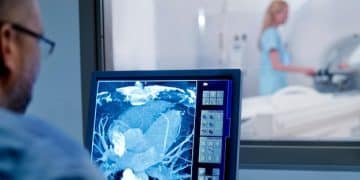
AI in Healthcare: Machine Learning Boosts Diagnostic Accuracy in US Hospitals
AI in Healthcare is revolutionizing diagnostic accuracy in US hospitals, with machine learning models enhancing precision by 10%, leading to earlier diagnoses and improved patient outcomes.
The integration of AI in Healthcare: Improving Diagnostic Accuracy by 10% with Machine Learning in US Hospitals is rapidly transforming how medical professionals approach diagnostics. By leveraging machine learning algorithms, healthcare providers in the United States are experiencing significant improvements in diagnostic precision, ultimately leading to better patient care and outcomes.
The Rise of AI in US Healthcare Diagnostics
The healthcare industry in the United States is undergoing a technological revolution, with artificial intelligence (AI) playing a pivotal role. AI’s capacity to analyze vast amounts of data, identify patterns, and provide insights beyond human capabilities is particularly impactful in diagnostics.
Benefits of AI-Driven Diagnostics
AI-driven diagnostics are not just about speed; they’re about enhancing accuracy and efficiency. The advantages are numerous, making AI an indispensable tool for modern healthcare.
- Early Detection: AI enables the identification of diseases at earlier stages, leading to timely intervention and improved treatment outcomes.
- Reduced Errors: By minimizing human error in interpreting medical images and data, AI ensures more accurate diagnoses.
- Enhanced Efficiency: AI automates routine tasks, freeing up healthcare professionals to focus on complex cases and patient care.
With these benefits, the integration of AI in US hospitals is set to transform diagnostic processes significantly. The potential for widespread improvements in patient outcomes is immense, marking a new era in healthcare excellence.

Machine Learning: The Engine Behind Diagnostic Accuracy
Machine learning (ML) is the driving force behind AI’s ability to enhance diagnostic accuracy. By training algorithms on massive datasets, ML models can recognize subtle patterns and predict outcomes with remarkable precision.
How Machine Learning Works in Diagnostics
Machine learning algorithms are trained on vast datasets of medical images, patient records, and other clinical information. This training enables the algorithms to recognize and classify patterns indicative of various diseases and conditions.
- Data Collection: Gathering extensive and diverse datasets is crucial for training robust ML models.
- Algorithm Training: ML algorithms are trained on labeled data, allowing them to learn the relationships between features and outcomes.
- Validation and Testing: ML models are rigorously tested to ensure they perform accurately and reliably in real-world clinical settings.
Through continuous learning and refinement, machine learning algorithms become increasingly adept at assisting healthcare professionals in making informed diagnostic decisions. This leads to improved accuracy and better patient outcomes.
Quantifying the Impact: A 10% Improvement in Diagnostic Accuracy
Recent studies have demonstrated that the implementation of AI and machine learning in diagnostics can lead to a 10% improvement in diagnostic accuracy, and in some cases, even more. This improvement has significant implications for patient care.
Real-World Examples of Improved Accuracy
Several US hospitals have reported substantial gains in diagnostic accuracy after integrating AI and machine learning tools into their workflows. Here are a few examples:
One hospital saw a 12% increase in the accuracy of diagnosing pneumonia from chest X-rays after implementing an AI-powered diagnostic tool. Another medical center achieved a 9% improvement in detecting early-stage lung cancer through AI-assisted CT scans. Furthermore, a children’s hospital improved the detection of congenital heart defects by 11% using machine learning models trained on echocardiogram data.
These improvements underscore the transformative potential of AI in healthcare diagnostics and highlight the importance of continued investment and innovation in this field.
Challenges and Ethical Considerations
Despite the promising benefits of AI in healthcare diagnostics, there are several challenges and ethical considerations that must be addressed to ensure responsible and equitable implementation.
Data Privacy and Security
Protecting patient data is of paramount importance, especially when dealing with sensitive health information. Here are some ways to ensure data privacy and security:
Maintaining the confidentiality and integrity of patient data, adhering to HIPAA regulations and other data protection laws, and implementing robust cybersecurity measures to prevent data breaches. Transparency in how patient data is used and shared is also important, as is giving patients control over their data and obtaining informed consent for the use of their data in AI models.
Algorithmic Bias
Algorithmic bias can lead to disparities in diagnostic accuracy across different patient populations. Addressing this challenge requires careful attention to diversity in training data and ongoing monitoring for bias.
- Diverse Datasets: Training AI models on diverse datasets that represent the patient population is crucial for minimizing bias.
- Bias Detection: Regularly assessing AI models for bias and implementing mitigation strategies is essential for equitable outcomes.
- Transparency and Explainability: Ensuring AI algorithms are transparent and explainable enhances trust and allows for scrutiny of potential biases.
By proactively addressing these challenges, healthcare providers can maximize the benefits of AI while minimizing the risks of unintended harm or discrimination.
The Future of AI in Healthcare Diagnostics
The future of AI in healthcare diagnostics holds immense promise, with ongoing research and development poised to unlock even greater potential
Emerging Trends and Innovations
Several emerging trends and innovations are shaping the future of AI in healthcare diagnostics. These developments include the integration of AI with wearable devices, the use of AI for personalized medicine, and the development of AI-powered diagnostic tools for underserved communities.
The integration of **AI in Healthcare** diagnostic tools for underserved communities has the potential to bring high-quality diagnostic services to remote and underserved areas. The fusion of AI with wearable devices enables continuous health monitoring and early detection of diseases, too. In addition, AI can analyze individual patient data to tailor treatment plans and therapies for optimized results.
The Continued Evolution of AI
As the technology matures and becomes more accessible, an even larger role for AI in healthcare diagnostics is expected. This evolution will involve a shift toward a more collaborative model, where AI works alongside clinicians to enhance their decision-making abilities and improve patient outcomes.
| Key Aspect | Brief Description |
|---|---|
| 🚀 Improved Accuracy | AI enhances diagnosis accuracy by 10% in US hospitals. |
| 💡 Machine Learning | ML algorithms analyze medical data for earlier detection. |
| 🛡️ Ethical Challenges | Addressing data privacy and algorithmic bias is crucial. |
| 🔮 Future Trends | AI-powered diagnostics are personalized and more accessible. |
FAQ
▼
AI enhances accuracy by analyzing vast amounts of medical data, identifying patterns, and reducing human error in interpreting images and records.
▼
Key challenges include ensuring data privacy and security, avoiding algorithmic biases in diagnostic outcomes, and validating the reliability of AI systems.
▼
AI algorithms can detect subtle anomalies in medical images and patient data that might be missed by human observers, leading to earlier diagnosis and intervention.
▼
Machine learning is the core of AI diagnostics, training algorithms on large datasets to recognize patterns and predict outcomes with increasing precision and accuracy.
▼
Healthcare organizations can ensure ethical use by prioritizing data privacy, mitigating algorithmic bias, promoting transparency, and involving diverse expertise in development.
Conclusion
The advancement of AI in Healthcare: Improving Diagnostic Accuracy by 10% with Machine Learning in US Hospitals signifies a monumental leap forward in medical science. With the potential to enhance diagnostic precision, early detection, and personalized treatment, AI is poised to reshape the landscape of healthcare, leading to better patient outcomes and more efficient medical practices throughout the United States and beyond.