AI-Driven Automation: Reshaping 15% of US Jobs by 2026

By 2026, AI-driven automation is projected to significantly reshape 15% of the US job market, demanding new skills, redefining roles, and creating both challenges and opportunities across various sectors.
The landscape of employment is continuously evolving, but the pace of change is accelerating dramatically with the advent of artificial intelligence. Our latest analysis reveals a compelling forecast for 2026: how AI-driven automation will reshape 15% of the US job market and what to expect, prompting a critical look at the future of work.
Understanding the Scope of AI-Driven Automation
Artificial intelligence, coupled with advanced automation, is no longer a futuristic concept but a present-day reality profoundly impacting industries. This transformation isn’t just about replacing human labor; it’s about augmenting capabilities, streamlining processes, and fundamentally altering how work is performed across various sectors. Understanding the nuances of this technological shift is crucial for individuals and organizations alike.
Defining AI and Automation in the Workplace
AI refers to systems that can perform tasks traditionally requiring human intelligence, such as learning, problem-solving, and decision-making. Automation, on the other hand, involves the use of technology to perform tasks with minimal human intervention. When combined, AI-driven automation enables machines to not only execute repetitive tasks but also to adapt, learn, and improve over time, leading to more sophisticated and autonomous operations.
- Process Automation: Automating repetitive, rule-based tasks in administrative and manufacturing roles.
- Cognitive Automation: Utilizing AI for tasks requiring judgment, such as data analysis, customer service, and content generation.
- Robotics: Physical robots performing manual labor in factories, logistics, and even healthcare.
- Predictive Analytics: AI-powered tools forecasting trends, optimizing resource allocation, and informing strategic decisions.
The integration of these technologies promises increased efficiency and productivity, but it also necessitates a re-evaluation of existing job structures and skill sets. The impact is not uniform, varying significantly based on the nature of the work and the industry’s readiness to adopt new tools.
Ultimately, the scope of AI-driven automation extends beyond simple task replacement. It encompasses a holistic re-imagining of workflows, demanding a proactive approach to skill development and strategic workforce planning to harness its full potential while mitigating potential disruptions.
Sectors Most Vulnerable to AI Reshaping
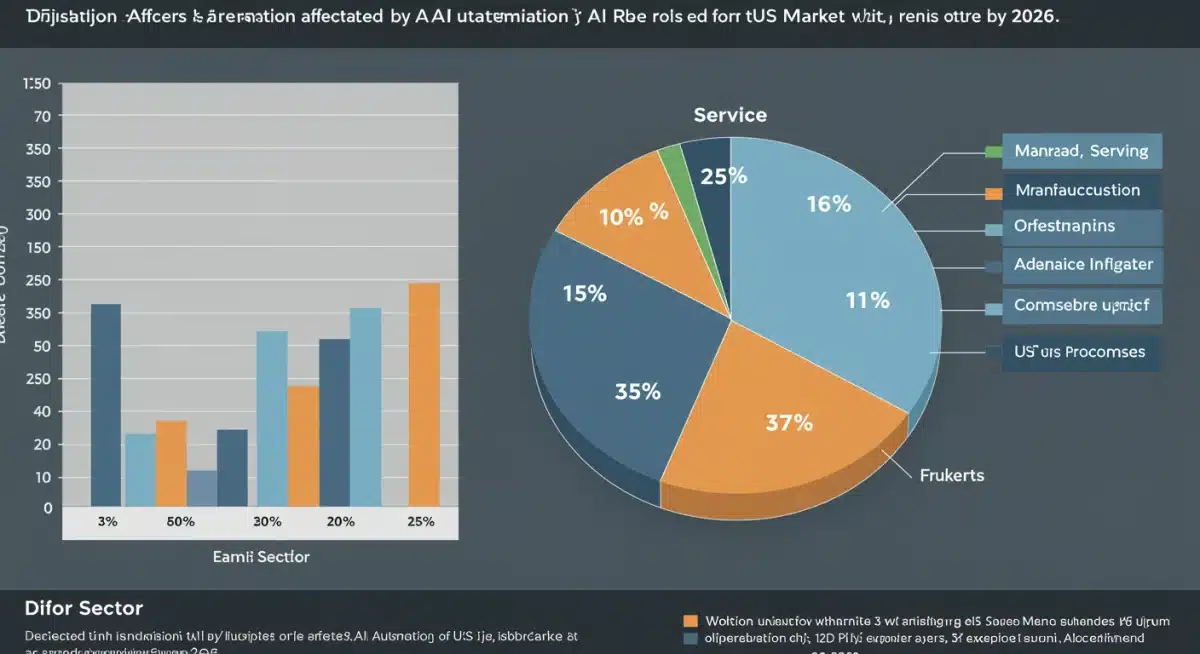
While AI-driven automation is a broad phenomenon, its impact will not be evenly distributed across all sectors of the US economy. Certain industries, characterized by high volumes of repetitive, data-intensive, or physically demanding tasks, are particularly susceptible to significant reshaping by 2026. Identifying these vulnerable sectors is key to preparing for the impending changes.
Administrative and clerical support roles, for instance, are prime candidates for automation. Tasks such as data entry, scheduling, and document processing can be efficiently handled by AI, leading to a significant reduction in the demand for human intervention in these areas. Similarly, manufacturing and logistics, already heavily reliant on automation, will see further advancements with AI-powered robotics and optimized supply chain management systems.
Key Vulnerable Industries and Roles
- Administrative and Office Support: Data entry clerks, administrative assistants, receptionists.
- Manufacturing and Production: Assembly line workers, machine operators, quality control inspectors.
- Transportation and Logistics: Truck drivers (with autonomous vehicles), warehouse workers, delivery personnel.
- Retail and Customer Service: Cashiers, call center agents, inventory management staff.
- Financial Services: Loan officers, data analysts, back-office processing roles.
These sectors are not necessarily facing complete elimination of jobs, but rather a profound transformation of existing roles. The emphasis will shift from routine task execution to oversight, maintenance, and problem-solving related to the automated systems. This requires a workforce capable of adapting to new technologies and embracing continuous learning.
The vulnerability of these sectors underscores the urgent need for strategic planning, including upskilling and reskilling initiatives, to ensure that the workforce can transition effectively into new or modified roles that leverage, rather than compete with, AI and automation. Addressing these challenges proactively will be critical for maintaining economic stability and fostering innovation.
Emerging Opportunities and New Job Creation
While the prospect of job displacement often dominates discussions about AI, it is equally important to recognize the significant opportunities and new job roles that AI-driven automation will create. The reshaping of the US job market isn’t solely about reduction; it’s also about evolution and expansion into entirely new domains.
The development, deployment, and maintenance of AI systems themselves will require a new generation of skilled professionals. This includes AI engineers, data scientists, machine learning specialists, and robotics technicians. Beyond direct AI roles, there will be an increased demand for professionals who can interpret AI outputs, manage human-AI collaboration, and ensure ethical AI deployment.
New Roles and Enhanced Human Capabilities
AI will also free up human workers from mundane and repetitive tasks, allowing them to focus on more creative, strategic, and interpersonal aspects of their jobs. This shift can lead to an enrichment of work, emphasizing uniquely human skills that AI cannot replicate.
- AI Trainers and Data Annotators: Professionals who train AI models and ensure data quality.
- AI Ethicists and Governance Specialists: Experts ensuring fair, transparent, and responsible AI development.
- Human-AI Interaction Designers: Creating intuitive interfaces for seamless collaboration between humans and AI.
- Robotics Maintenance and Repair Technicians: Specializing in the upkeep of automated physical systems.
- Creative and Strategic Roles: Enhanced demand for innovators, strategists, and problem-solvers in all industries.
Furthermore, AI’s ability to process vast amounts of data can lead to breakthroughs in areas like personalized medicine, sustainable energy, and advanced materials, thereby creating entirely new industries and job categories that are currently unforeseen. The key to leveraging these opportunities lies in fostering a culture of innovation and continuous learning.
The emergence of these new roles emphasizes a symbiotic relationship between humans and AI, where technology serves as a tool to amplify human potential rather than merely replace it. Preparing for these opportunities requires a forward-thinking approach to education and workforce development, focusing on adaptability and interdisciplinary skills.
The Importance of Reskilling and Upskilling Initiatives
Given the significant reshaping predicted for the US job market by 2026, the imperative for widespread reskilling and upskilling initiatives cannot be overstated. As AI-driven automation takes over routine tasks, the workforce must adapt by acquiring new competencies that complement or leverage these advanced technologies. This proactive approach is vital for individuals to remain employable and for the economy to thrive.
Reskilling involves training individuals for entirely new job roles, especially those emerging due to AI. Upskilling, conversely, focuses on enhancing existing skills to perform current jobs more effectively in an AI-integrated environment. Both are critical components of a comprehensive strategy to navigate the evolving labor landscape.
Strategies for Workforce Adaptation
- Government-Sponsored Programs: Investing in public education and vocational training focused on digital literacy, AI literacy, and advanced technical skills.
- Corporate Training Initiatives: Companies offering internal programs to retrain employees for new roles or upgrade their skills to work with AI tools.
- Online Learning Platforms: Accessibility to online courses and certifications in AI, data science, coding, and automation technologies.
- Partnerships with Educational Institutions: Collaborations between businesses and universities to develop curricula that meet future workforce demands.
The success of these initiatives hinges on a collaborative effort between government, educational institutions, and the private sector. It requires identifying future skill gaps, developing accessible training pathways, and incentivizing lifelong learning. Without a robust framework for continuous learning, a significant portion of the workforce risks being left behind.
Ultimately, investing in human capital through targeted reskilling and upskilling programs is not just about mitigating job displacement; it’s about fostering a dynamic, adaptable workforce capable of driving innovation and economic growth in an AI-powered future. This commitment to continuous learning will be a defining characteristic of successful economies.
Economic and Societal Implications of AI in the Workforce
The widespread integration of AI-driven automation into the US job market carries profound economic and societal implications that extend beyond individual employment. While the promise of increased productivity and economic growth is significant, there are also challenges related to income inequality, social equity, and the very nature of human work that demand careful consideration.
On the economic front, AI could lead to a significant boost in productivity, potentially driving down costs and making goods and services more accessible. However, this efficiency gain might not be evenly distributed. Businesses that successfully adopt AI could see disproportionate gains, potentially widening the gap between highly skilled workers in AI-related fields and those in roles susceptible to automation.
Addressing Disparities and Ensuring Equitable Transition
Societally, the impact is multifaceted. There’s a risk of increased social stratification if access to reskilling opportunities is not equitable. Communities heavily reliant on industries facing automation could experience significant disruption, leading to social unrest if not adequately managed.
- Income Inequality: Potential for a widening gap between high-skill AI-enabled jobs and low-skill automated roles.
- Social Safety Nets: Debate around universal basic income (UBI) or enhanced unemployment benefits to support displaced workers.
- Ethical AI Development: Ensuring AI is developed and deployed responsibly, without biases that could exacerbate existing inequalities.
- Work-Life Balance: Automation could free up time, but also blur the lines between work and leisure, impacting mental well-being.
Policymakers face the complex task of designing frameworks that encourage AI adoption for economic benefit while simultaneously protecting vulnerable populations. This includes investments in education, social support systems, and regulations that promote fair labor practices in an automated economy.
Navigating these implications requires a holistic approach that considers not just technological advancements, but also the human element. Striking a balance between innovation and social responsibility will be paramount to ensuring that AI’s benefits are shared broadly across society, fostering a future where technology enhances human flourishing.
Preparing for the Future: A Strategic Approach
As the 2026 deadline for significant AI-driven job market reshaping approaches, a strategic and multifaceted approach is essential for individuals, businesses, and policymakers alike. Proactive preparation, rather than reactive measures, will determine success in navigating this transformative period. This involves foresight, adaptability, and a commitment to continuous evolution.
For individuals, this means cultivating a mindset of lifelong learning. The skills valued today might be obsolete tomorrow, making adaptability and the willingness to acquire new competencies paramount. Focusing on uniquely human skills—creativity, critical thinking, emotional intelligence, and complex problem-solving—will provide a significant advantage.
Key Pillars of Preparation
- Individual Empowerment: Investing in personal learning, skill development, and career planning.
- Business Innovation: Companies embracing AI for competitive advantage while strategically integrating human talent.
- Policy Development: Governments creating supportive regulations, educational reforms, and social safety nets.
- Interdisciplinary Collaboration: Fostering partnerships between academia, industry, and government to address challenges holistically.
Businesses must move beyond simply automating tasks and instead focus on how AI can augment their workforce, creating hybrid roles that combine human ingenuity with machine efficiency. This requires strategic workforce planning, investing in employee training, and fostering a culture of innovation.
Policymakers have a crucial role in establishing an ecosystem that supports this transition. This includes reforming education systems to emphasize future-ready skills, creating incentives for businesses to invest in their workforce, and developing social policies that cushion the impact of job displacement. Collaboration across all sectors will be vital to ensure a smooth and equitable transition.
Ultimately, preparing for the future means embracing change as an opportunity. By strategically planning and investing in both technology and human capital, the US can harness the power of AI-driven automation to build a more productive, innovative, and resilient economy, ensuring that the benefits of this technological revolution are widely shared and truly transformative.
| Key Aspect | Brief Description |
|---|---|
| Job Reshaping Extent | 15% of US job market projected to be reshaped by AI-driven automation by 2026. |
| Vulnerable Sectors | Administrative, manufacturing, logistics, retail, and financial services are most impacted. |
| Emerging Opportunities | New roles in AI development, ethical AI, human-AI interaction, and creative fields. |
| Key Preparation | Reskilling, upskilling, policy development, and fostering human-centric skills are crucial. |
Frequently Asked Questions About AI and the Job Market
It means that approximately 15% of existing job roles will undergo significant changes by 2026 due to AI and automation. This includes tasks being automated, roles being redefined, and new responsibilities emerging, rather than outright elimination of all jobs within that percentage.
Roles involving repetitive, predictable tasks are most susceptible, such as data entry, administrative support, manufacturing assembly, and certain customer service positions. However, even these roles may evolve to include oversight and management of AI systems.
Yes, AI is expected to create new jobs, particularly in areas like AI development, data science, ethical AI governance, and roles requiring uniquely human skills like creativity and complex problem-solving. The challenge lies in ensuring workers are equipped for these emerging opportunities.
Focus on skills that AI cannot easily replicate, such as critical thinking, creativity, emotional intelligence, complex problem-solving, and adaptability. Digital literacy, data analysis, and understanding AI principles will also be highly valuable.
Businesses should invest in comprehensive reskilling and upskilling programs for their employees, foster a culture of continuous learning, and strategically integrate AI tools to augment human capabilities rather than solely replace them. Proactive workforce planning is key.
Conclusion
The forecast for 2026: how AI-driven automation will reshape 15% of the US job market and what to expect presents both a formidable challenge and an unprecedented opportunity. While the transformation of existing roles is inevitable, the emergence of new job categories and the enhancement of human capabilities offer a promising outlook. Successfully navigating this era demands a concerted effort from individuals, businesses, and governments to prioritize continuous learning, strategic adaptation, and ethical development. By embracing a proactive stance, the US workforce can not only withstand the shifts but also thrive, leveraging AI as a powerful tool for innovation and shared prosperity.