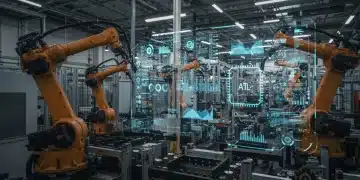
AI Automation: 20% Cost Reduction in US Manufacturing by 2025

AI-powered automation is projected to reduce operational costs by an impressive 20% in US manufacturing by 2025, fundamentally transforming production processes and enhancing global competitiveness.
The manufacturing landscape in the United States is on the cusp of a profound transformation. The promise of FINANCIAL IMPACT: Reducing Operational Costs by 20%: Leveraging AI-Powered Automation in US Manufacturing for 2025 is not merely a futuristic vision but a tangible goal within reach. This shift is driven by the strategic integration of artificial intelligence and automation, promising unparalleled efficiency and competitiveness.
The Dawn of AI in US Manufacturing
The US manufacturing sector, traditionally a powerhouse of innovation, is now embracing Artificial Intelligence (AI) and automation with unprecedented fervor. This adoption is not just about keeping pace with global trends; it’s about redefining efficiency, quality, and ultimately, profitability. The integration of AI technologies, from machine learning algorithms to robotic process automation, is fundamentally reshaping how factories operate, promising significant cost reductions and a boost in productivity.
Beyond simple task automation, AI brings a new level of intelligence to manufacturing processes. It enables predictive maintenance, optimizes supply chains, enhances quality control, and even assists in product design. This holistic approach to technological integration is what sets the current wave of AI adoption apart from previous industrial revolutions. Manufacturers are beginning to see AI not as a replacement for human labor, but as a powerful augmentation that allows for more strategic and efficient resource allocation.
Understanding the AI-Driven Cost Reduction Potential
The 20% operational cost reduction target by 2025 is ambitious but achievable, primarily due to several key areas where AI delivers substantial financial benefits. These areas range from optimizing energy consumption to minimizing waste and improving labor efficiency. The cumulative effect of these optimizations creates a significant positive financial impact for manufacturers.
- Predictive Maintenance: AI algorithms analyze sensor data from machinery to predict equipment failures before they occur, reducing downtime and costly emergency repairs.
- Optimized Resource Allocation: AI can manage inventory, energy usage, and even workforce scheduling with greater precision, leading to substantial savings.
- Enhanced Quality Control: AI-powered vision systems detect defects faster and more accurately than human inspection, reducing scrap rates and rework.
The strategic implementation of AI in these critical operational facets provides a clear path to achieving the targeted cost reductions. It transforms reactive processes into proactive, data-driven strategies, allowing manufacturers to operate with greater foresight and control. This proactive stance is crucial for maintaining a competitive edge in a rapidly evolving global market.
In essence, the dawn of AI in US manufacturing signifies a shift towards smarter, more resilient, and ultimately, more profitable operations. The initial investments in AI infrastructure and training are quickly offset by the long-term financial gains and enhanced operational capabilities. This technological evolution is not merely an option but a necessity for manufacturers aiming for sustained growth and leadership.
Key Pillars of AI Automation for Cost Savings
To achieve the ambitious goal of a 20% operational cost reduction, US manufacturing must strategically deploy AI automation across several critical operational pillars. These pillars represent the core areas where AI can deliver the most significant and measurable financial impact. Focusing on these areas ensures a comprehensive approach to efficiency and optimization, moving beyond isolated improvements to systemic transformation.
The integration of AI into these foundational aspects of manufacturing creates a synergistic effect, where improvements in one area positively influence others. This interconnectedness is a hallmark of intelligent automation, allowing for a more agile and responsive production environment. Manufacturers are finding that the initial investment in AI infrastructure pays dividends across the entire operational spectrum.
Predictive Maintenance and Downtime Reduction
One of the most immediate and significant benefits of AI in manufacturing is its ability to revolutionize maintenance practices. Traditional maintenance often involves scheduled checks or reactive repairs after a breakdown, both of which can be inefficient and costly. AI-powered predictive maintenance shifts this paradigm entirely.
- Sensor Data Analysis: AI algorithms continuously analyze data from machine sensors (temperature, vibration, pressure) to identify subtle anomalies indicating potential failure.
- Maintenance Scheduling Optimization: Based on these predictions, maintenance can be scheduled precisely when needed, minimizing unexpected downtime and maximizing asset utilization.
- Reduced Repair Costs: Addressing issues before they escalate into major breakdowns significantly lowers repair costs and extends the lifespan of expensive equipment.
By leveraging AI for predictive maintenance, manufacturers can move from a reactive or time-based approach to a condition-based strategy, dramatically reducing unscheduled downtime and associated production losses. This proactive stance not only saves money but also enhances overall operational reliability and output consistency.
Optimizing Supply Chain and Inventory Management
The supply chain and inventory management are ripe for AI-driven optimization, offering substantial cost-saving opportunities. Inefficient supply chains can lead to excessive inventory holding costs, stockouts, and delays, all of which negatively impact the bottom line. AI provides the tools to bring unprecedented precision to these complex processes.
AI models can analyze vast datasets, including historical sales, market trends, weather patterns, and geopolitical events, to forecast demand with remarkable accuracy. This improved forecasting directly translates into better inventory management, ensuring that manufacturers have the right amount of materials at the right time, avoiding both shortages and costly overstocking. Furthermore, AI can optimize logistics, identifying the most efficient routes and transportation methods, leading to reduced shipping costs and faster delivery times.
The ability of AI to process and interpret complex, dynamic data sets allows for real-time adjustments to supply chain strategies, making them more resilient and adaptable to unforeseen disruptions. This agility is a critical advantage in today’s volatile global market, safeguarding against potential losses due to supply chain inefficiencies.
Enhanced Quality Control and Waste Reduction
Defective products and material waste represent significant financial drains for manufacturers. AI-powered quality control systems offer a powerful solution to these challenges, improving product consistency and reducing scrap rates. Vision systems equipped with AI can inspect products at high speeds and with greater accuracy than human eyes, identifying flaws that might otherwise go unnoticed.

Beyond detection, AI can also identify the root causes of defects by analyzing production data, allowing manufacturers to make process adjustments that prevent future occurrences. This proactive approach to quality not only reduces waste but also enhances brand reputation and customer satisfaction, leading to long-term financial benefits. The precision of AI in quality assurance is a game-changer for industries where even minor imperfections can lead to significant losses.
By focusing on these key pillars, US manufacturers can systematically dismantle inefficiencies, drive down operational costs, and build a more robust and competitive future. AI automation is not just an incremental improvement; it’s a foundational shift that redefines what’s possible in modern manufacturing.
Real-World AI Applications Driving Efficiency
The theoretical benefits of AI in manufacturing are compelling, but it’s the real-world applications that truly demonstrate its transformative power. Across various sectors of US manufacturing, companies are implementing AI solutions that are tangibly contributing to the targeted 20% operational cost reduction. These applications span from the factory floor to the executive boardroom, optimizing processes at every level.
From advanced robotics working seamlessly alongside human operators to sophisticated software platforms managing complex data streams, AI is becoming an indispensable tool. The practical examples highlight how diverse industries are adapting AI to their specific needs, demonstrating the versatility and scalability of these technologies. These success stories serve as blueprints for wider adoption and illustrate the concrete financial gains achievable.
Robotics and Collaborative Automation
Robots have been a staple in manufacturing for decades, but AI is elevating their capabilities to new heights. Collaborative robots (cobots), powered by AI, can work safely alongside humans, taking on repetitive or dangerous tasks while humans focus on more complex, value-added activities. This collaboration not only boosts productivity but also improves workplace safety.
- Precision Assembly: AI-guided robots can perform intricate assembly tasks with extreme precision, reducing errors and improving product quality.
- Material Handling: Automated guided vehicles (AGVs) and autonomous mobile robots (AMRs) use AI to navigate factory floors, transport materials efficiently, and optimize logistics.
- Flexible Manufacturing: AI allows robots to be reprogrammed quickly for different tasks, enabling greater flexibility in production lines and faster adaptation to market changes.
The integration of AI into robotics makes automated systems more intelligent, adaptable, and cost-effective. These systems require less human intervention for routine operations, freeing up valuable labor for oversight, programming, and innovation. The result is a more dynamic and efficient production environment capable of meeting diverse demands.
Generative Design and Product Development
AI is also making significant inroads into the early stages of the manufacturing process – product design and development. Generative design, a powerful AI application, allows engineers to input design parameters and constraints, and the AI then explores thousands of design options, often proposing innovative solutions that human designers might not conceive.
This capability dramatically accelerates the design cycle, reduces the need for multiple physical prototypes, and often leads to designs that are lighter, stronger, and more material-efficient. By optimizing designs for manufacturing from the outset, generative AI directly contributes to cost savings in material usage, production time, and waste reduction. It also fosters innovation, allowing companies to bring highly optimized and novel products to market faster, enhancing their competitive edge and profitability.
AI in Energy Management and Sustainability
Beyond direct production processes, AI is proving invaluable in optimizing ancillary operations, particularly energy management. Manufacturing facilities are significant consumers of energy, and even marginal improvements in efficiency can lead to substantial cost savings. AI systems can monitor energy consumption patterns across an entire plant, identifying inefficiencies and recommending optimizations.
This includes dynamically adjusting heating, ventilation, and air conditioning (HVAC) systems, optimizing machine run times, and even managing renewable energy integration. By leveraging AI, manufacturers can significantly reduce their energy footprint, lowering utility bills and contributing to sustainability goals. This dual benefit of cost reduction and environmental responsibility makes AI in energy management a compelling application for modern manufacturing.
These real-world applications underscore that AI automation is not just a theoretical concept but a practical tool delivering tangible financial and operational benefits. As more manufacturers adopt these technologies, the collective impact on the US manufacturing sector’s efficiency and competitiveness will continue to grow, solidifying its position as a global leader.
Overcoming Implementation Challenges
While the promise of AI-powered automation to reduce operational costs by 20% in US manufacturing is immense, its implementation is not without challenges. Manufacturers must navigate a complex landscape of technological, organizational, and workforce hurdles to fully realize AI’s potential. Addressing these challenges proactively is crucial for a successful and cost-effective AI integration strategy.
The journey to AI adoption requires more than just purchasing new software or hardware; it demands a fundamental shift in mindset, processes, and skills. Companies that acknowledge and prepare for these challenges are better positioned to reap the full benefits of AI automation, ensuring that their investments yield the desired financial impact and operational improvements.
Data Integration and Infrastructure
A primary challenge lies in data. AI systems are only as good as the data they are trained on, and many manufacturing facilities struggle with fragmented, inconsistent, or siloed data. Integrating data from disparate systems – ERP, MES, SCADA, sensor networks – into a unified, clean, and accessible format is a monumental task.
- Legacy Systems: Many manufacturers operate with older, proprietary systems that are not easily integrated with modern AI platforms.
- Data Quality: Ensuring the accuracy, completeness, and consistency of data is vital for reliable AI model performance.
- Scalable Infrastructure: Building a robust and scalable IT infrastructure capable of handling vast amounts of data generated by AI and IoT devices is essential.
Overcoming these data challenges often requires significant investment in data infrastructure, integration platforms, and data governance strategies. Without a solid data foundation, AI initiatives are likely to underperform, failing to deliver the expected cost reductions and operational efficiencies.
Skilled Workforce and Training Gaps
The introduction of AI automation necessitates a workforce with new skills. There’s a growing gap between the demand for AI-savvy professionals and the available talent pool. Existing employees often lack the expertise in areas like data science, AI programming, robotics maintenance, and advanced analytics.
Manufacturers must invest heavily in upskilling and reskilling their current workforce. This includes training programs for engineers on AI toolkits, for technicians on maintaining AI-powered robots, and for managers on how to leverage AI insights for strategic decision-making. Addressing this skills gap is critical to ensure that the human element of manufacturing can effectively collaborate with and manage AI systems, maximizing their impact on cost reduction.
Cybersecurity and Ethical Considerations
As manufacturing operations become more interconnected and reliant on AI, the attack surface for cyber threats expands significantly. Protecting proprietary data, operational technology (OT) systems, and intellectual property from cyberattacks becomes paramount. A security breach can lead to significant financial losses, operational disruption, and reputational damage, negating any cost savings achieved through AI.
Furthermore, ethical considerations surrounding AI deployment, such as data privacy, algorithmic bias, and the impact on employment, must be carefully addressed. Manufacturers need to develop robust cybersecurity frameworks and ethical guidelines to ensure responsible and secure AI implementation, building trust and ensuring long-term sustainability of their AI initiatives.
Successfully navigating these implementation challenges requires a comprehensive strategy that encompasses technological upgrades, workforce development, and robust governance. Companies that approach AI adoption with a clear understanding of these hurdles are more likely to achieve their financial objectives and establish a resilient, future-ready manufacturing operation.
Measuring the Return on Investment (ROI) of AI
For US manufacturers, the decision to invest in AI-powered automation hinges on a clear understanding of its financial returns. Measuring the Return on Investment (ROI) of AI initiatives is paramount to justify expenditures, secure executive buy-in, and continuously optimize deployment strategies. While the benefits are often multifaceted, a systematic approach to quantifying them is essential for validating the 20% operational cost reduction target.
Calculating AI ROI extends beyond direct cost savings; it also encompasses gains from improved efficiency, enhanced quality, faster time-to-market, and increased competitive advantage. Manufacturers need to establish clear metrics and benchmarks before, during, and after AI implementation to accurately assess its impact and ensure that the technology is delivering its promised value.
Quantifying Direct Cost Savings
Direct cost savings are often the most straightforward to measure and form a significant part of the AI ROI calculation. These savings typically stem from reductions in specific operational expenditures that AI directly influences.
- Labor Cost Reduction: While AI automates tasks, it often shifts roles rather than eliminates them entirely. Savings come from optimizing labor allocation and reducing overtime.
- Material Waste Reduction: AI-driven quality control and process optimization lead to less scrap and rework, directly saving on raw material costs.
- Energy Consumption: AI-optimized energy management systems can significantly lower utility bills.
- Maintenance Expenses: Predictive maintenance reduces emergency repairs, parts replacement, and unplanned downtime costs.
By tracking these specific line items, manufacturers can build a compelling case for AI investments. It’s crucial to establish baseline costs before AI implementation to accurately demonstrate the financial improvements attributable to the new technology.
Indirect Benefits and Strategic Value
Beyond direct cost savings, AI delivers a host of indirect benefits that contribute significantly to a manufacturer’s strategic value and long-term profitability. These benefits, while sometimes harder to quantify in immediate financial terms, are critical for sustainable growth and competitiveness.
Improved product quality, for instance, leads to higher customer satisfaction, reduced warranty claims, and a stronger brand reputation, all of which indirectly boost sales and market share. Faster product development cycles, enabled by generative design and AI-assisted engineering, allow companies to respond more quickly to market demands, capturing new opportunities ahead of competitors. Enhanced supply chain resilience, a key outcome of AI optimization, protects against disruptions that could otherwise lead to massive financial losses.
Furthermore, the data insights generated by AI can inform strategic business decisions, leading to more efficient capital allocation and better long-term planning. These strategic advantages, when combined with direct cost reductions, paint a comprehensive picture of AI’s profound impact on a manufacturing enterprise’s overall health and future trajectory.
Establishing Metrics and Benchmarks
To effectively measure AI ROI, manufacturers must establish clear, measurable metrics and benchmarks before embarking on any AI project. These should align with the specific goals of the AI implementation, whether it’s reducing downtime, improving throughput, or cutting energy costs. Key Performance Indicators (KPIs) must be defined and consistently tracked.
This includes setting baselines for current operational costs, efficiency rates, and quality metrics. Regular monitoring and reporting on these KPIs post-implementation allow companies to evaluate the effectiveness of their AI solutions, identify areas for improvement, and demonstrate concrete financial gains. A robust measurement framework ensures accountability and provides the data necessary to continuously refine AI strategies for maximum impact.
Ultimately, a holistic approach to measuring AI ROI, encompassing both direct cost savings and indirect strategic benefits, is essential for US manufacturers aiming to achieve and surpass the 20% operational cost reduction target. This rigorous evaluation ensures that AI investments are not just technologically advanced but also financially sound and strategically beneficial.
The Future Landscape: Beyond 2025
As US manufacturing approaches and potentially surpasses the 20% operational cost reduction target by 2025 through AI-powered automation, the question naturally arises: what lies beyond? The journey of AI integration is not a destination but a continuous evolution. The future landscape promises even more sophisticated applications, deeper integration, and a manufacturing sector that is more agile, resilient, and responsive than ever before.
The foundational changes being implemented now will pave the way for a truly intelligent manufacturing ecosystem. This future will be characterized by hyper-personalization, autonomous decision-making, and a seamless blend of physical and digital operations, further cementing the US’s position as a leader in industrial innovation.
Hyper-Personalization and Mass Customization
One of the most exciting prospects beyond 2025 is the widespread adoption of hyper-personalization and mass customization, enabled by advanced AI. Currently, mass production focuses on standardization; however, AI will allow manufacturers to produce highly customized products at the cost and speed of mass production. This will involve AI-driven flexible manufacturing systems that can rapidly reconfigure, adapt to individual customer specifications, and optimize production batches of one.
- AI-Driven Design: Customers will be able to design unique products with AI assistance, which then directly feeds into the automated production line.
- Adaptive Production: AI will manage complex scheduling and resource allocation for diverse product variations, ensuring efficient production without extensive retooling.
- Demand Forecasting: Even more sophisticated AI models will predict individual customer preferences, allowing for proactive, personalized manufacturing.
This shift will not only cater to evolving consumer demands but also open up new revenue streams and competitive advantages for manufacturers, moving beyond cost reduction to value creation at an unprecedented scale.
Autonomous Factories and Edge AI
The concept of fully autonomous factories, where AI systems manage and optimize nearly every aspect of production with minimal human intervention, will move closer to reality. Edge AI, processing data directly on devices rather than in the cloud, will play a crucial role in this evolution. This enables real-time decision-making, reduces latency, and enhances data security.
Autonomous factories, powered by sophisticated AI, will be capable of self-diagnosis, self-optimization, and self-correction, leading to unprecedented levels of efficiency and resilience. Human roles will shift towards oversight, strategic planning, and managing the AI systems themselves, rather than direct operational tasks.
Sustainability and Circular Economy Integration
AI’s role in advancing sustainability and the circular economy will become even more pronounced. Beyond energy efficiency, AI will optimize material usage, facilitate recycling and repurposing processes, and design products for longevity and easy disassembly. This will not only reduce environmental impact but also create new economic opportunities through resource recovery and closed-loop manufacturing.
AI models will track product lifecycles, predict material degradation, and identify optimal pathways for component reuse, transforming manufacturing into a more environmentally responsible and resource-efficient industry. The synergy between AI and sustainability will drive not just cost reduction but also long-term ecological and economic benefits.
The future of US manufacturing, propelled by AI, promises a dynamic, efficient, and highly adaptive sector. The gains achieved by 2025 will be just the beginning, setting the stage for continuous innovation and a new era of industrial excellence.
Strategic Imperatives for US Manufacturers
Achieving the ambitious goal of a 20% operational cost reduction by 2025 through AI-powered automation in US manufacturing requires more than just technological adoption; it demands strategic imperatives that guide companies through this transformative journey. Manufacturers must cultivate a forward-thinking culture, invest wisely, and foster collaboration to unlock AI’s full potential and secure a competitive future.
These strategic imperatives are not merely recommendations; they are critical pathways for survival and growth in an increasingly technology-driven global market. Companies that embrace these principles will be better positioned to navigate the complexities of AI integration, realize significant financial benefits, and lead the charge in the next industrial era.
Fostering an Innovation-Driven Culture
The most successful AI integrations begin with a culture that champions innovation, continuous learning, and adaptability. Resistance to change can be a significant barrier to AI adoption. Manufacturers need to create an environment where employees are encouraged to experiment with new technologies, share insights, and embrace new ways of working.
- Leadership Buy-in: Executive leadership must actively promote and support AI initiatives, signaling their importance to the entire organization.
- Cross-Functional Teams: Encourage collaboration between IT, operations, engineering, and R&D teams to ensure holistic AI deployment.
- Continuous Learning: Invest in ongoing education and training programs to keep the workforce updated with the latest AI tools and methodologies.
An innovation-driven culture ensures that AI is not just implemented but integrated thoughtfully and effectively, maximizing its impact on operational efficiency and cost reduction.
Strategic Partnerships and Ecosystem Development
No single manufacturer can develop all the necessary AI expertise and infrastructure in-house. Strategic partnerships with AI solution providers, research institutions, and even other manufacturers can accelerate AI adoption and mitigate risks. Collaborating within an AI ecosystem allows companies to leverage specialized knowledge, share best practices, and access cutting-edge technologies.
These partnerships can range from co-developing custom AI applications to sharing data for collective insights (within secure frameworks) or participating in industry consortia focused on AI standards. By building a robust network, manufacturers can overcome resource constraints, reduce development costs, and stay at the forefront of AI innovation, directly contributing to their financial objectives.
Prioritizing Data Governance and Security
As AI becomes central to manufacturing operations, the importance of robust data governance and cybersecurity cannot be overstated. High-quality, secure data is the lifeblood of effective AI. Manufacturers must establish clear policies for data collection, storage, usage, and privacy, ensuring compliance with regulations and protecting sensitive operational information.
Implementing advanced cybersecurity measures, including intrusion detection systems, encryption, and regular security audits, is critical to safeguard AI systems and connected industrial control systems from cyber threats. A proactive approach to data governance and security builds trust, prevents costly breaches, and ensures the integrity and reliability of AI-driven processes, thereby protecting the financial investments made in automation.
By embracing these strategic imperatives, US manufacturers can confidently navigate the complexities of AI integration, not only achieving but potentially exceeding the 20% operational cost reduction target by 2025. This strategic foresight will ensure sustained competitiveness and leadership in the global manufacturing arena.
| Key Aspect | Impact on Cost Reduction |
|---|---|
| Predictive Maintenance | Reduces unplanned downtime and expensive emergency repairs by anticipating equipment failures. |
| Supply Chain Optimization | Minimizes inventory holding costs, prevents stockouts, and optimizes logistics for lower shipping expenses. |
| Quality Control & Waste Reduction | Decreases scrap rates and rework costs through precise, AI-powered defect detection and root cause analysis. |
| Energy Management | Lowers utility costs by optimizing energy consumption patterns across the manufacturing facility. |
Frequently Asked Questions About AI in Manufacturing
AI-powered automation in US manufacturing involves integrating artificial intelligence technologies, such as machine learning and robotics, into production processes. This aims to enhance efficiency, reduce human error, and optimize various operational aspects from supply chain management to quality control, ultimately leading to significant cost reductions and improved output.
AI can reduce operational costs by optimizing maintenance schedules through predictive analytics, minimizing waste with enhanced quality control systems, improving supply chain efficiency, and fine-tuning energy consumption. These combined efficiencies are projected to deliver substantial savings, making the 20% goal achievable for many US manufacturers by 2025.
Key challenges include integrating fragmented legacy data systems, addressing the shortage of skilled AI professionals, and ensuring robust cybersecurity measures against new threats. Overcoming these requires significant investment in infrastructure, workforce training, and strategic partnerships, alongside a commitment to data governance and ethical AI deployment.
Applications like predictive maintenance, which reduces unplanned downtime, and AI-driven quality control, which minimizes defects and waste, are exceptionally impactful. Additionally, AI in supply chain optimization, energy management, and generative design for product development also contribute significantly to reducing operational expenditures and improving efficiency across the board.
AI automation typically shifts, rather than eliminates, human roles. It automates repetitive tasks, allowing the workforce to focus on higher-value activities such as strategic oversight, complex problem-solving, and managing AI systems. This necessitates upskilling and reskilling programs to equip employees with the new competencies required for an AI-integrated manufacturing environment.
Conclusion
The ambitious target of achieving a 20% reduction in operational costs within US manufacturing by 2025, driven by AI-powered automation, is not merely a forecast but a strategic imperative that is already taking shape. From enhanced predictive maintenance and optimized supply chains to superior quality control and efficient energy management, AI is fundamentally reshaping the operational blueprint of American factories. While challenges related to data integration, workforce upskilling, and cybersecurity persist, a proactive and strategic approach can effectively mitigate these hurdles. The continuous evolution of AI promises a future where manufacturing is more agile, sustainable, and capable of mass customization, ensuring sustained competitiveness and prosperity for the US industrial sector.