AI Predictive Maintenance: Cutting Downtime by 15% in US Manufacturing by 2025

AI-powered predictive maintenance is set to revolutionize US manufacturing by 2025, reducing equipment downtime by an estimated 15% through advanced algorithms that analyze equipment data to predict failures and schedule maintenance proactively.
Imagine a future where factory floors hum with efficiency, not punctuated by the jarring halts of unexpected breakdowns. This isn’t just a daydream; it’s a rapidly approaching reality powered by AI-powered predictive maintenance. By 2025, expect to see US manufacturing significantly reduce equipment downtime, potentially by as much as 15%, thanks to these innovative technologies.
The Rise of AI in US Manufacturing
The US manufacturing sector is undergoing a significant transformation, driven by advances in artificial intelligence. Among the most promising applications is predictive maintenance, which leverages AI to anticipate equipment failures and optimize maintenance schedules. This proactive approach promises to minimize downtime and boost productivity.
Understanding Predictive Maintenance
Predictive maintenance uses data analysis and machine learning to monitor the condition of equipment and predict when maintenance is needed. This contrasts with traditional methods, such as reactive maintenance (fixing equipment after it breaks down) and preventive maintenance (performing maintenance at fixed intervals, regardless of the equipment’s condition).
Benefits of AI-Driven Predictive Maintenance
The integration of AI into predictive maintenance offers numerous advantages, including improved accuracy, reduced costs, and increased efficiency. AI algorithms can process vast amounts of data from various sources, such as sensors, historical maintenance records, and environmental conditions, to identify patterns and predict failures with greater precision than traditional methods.
- Reduced Equipment Downtime: AI predicts failures, allowing for timely maintenance.
- Lower Maintenance Costs: Optimizes maintenance schedules and reduces unnecessary interventions.
- Improved Asset Utilization: Extends equipment lifespan and maximizes its operational efficiency.
- Enhanced Safety: Prevents catastrophic equipment failures, ensuring a safer working environment.
In conclusion, AI’s integration into predictive maintenance is revolutionizing the US manufacturing sector by offering a proactive, data-driven approach. This shift leads to significant gains in efficiency, cost savings, and overall operational performance, positioning US manufacturers for enhanced competitiveness.
Why 2025 is a Tipping Point for US Manufacturing
Several factors converge to make 2025 a crucial year for the adoption of **AI-powered predictive maintenance** in US manufacturing. These include advancements in AI technology, increasing data availability, and growing pressure to enhance productivity and reduce costs.
Advancements in AI Technology
AI technology is rapidly evolving, with new algorithms and techniques emerging regularly. These advancements are making AI-powered predictive maintenance more accurate, reliable, and accessible to manufacturers of all sizes. Machine learning models are becoming more sophisticated, capable of handling complex datasets and providing more precise predictions.
Increasing Data Availability
The proliferation of sensors and IoT devices is generating vast amounts of data on equipment performance. This data provides the raw material for AI algorithms to learn from and make predictions. As more manufacturers adopt smart manufacturing practices, the volume and quality of data available for predictive maintenance will continue to increase.

The convergence of these factors is creating a perfect storm for the widespread adoption of AI-powered predictive maintenance. By 2025, it is expected that a significant portion of US manufacturers will have implemented these technologies, leading to substantial improvements in productivity and competitiveness.
How AI Algorithms Predict Equipment Failures
The core of **AI-powered predictive maintenance** lies in the sophisticated algorithms that analyze equipment data to predict failures. These algorithms use a variety of techniques, including machine learning, statistical analysis, and rule-based systems, to identify patterns and anomalies that indicate potential problems.
Machine Learning
Machine learning algorithms are trained on historical data to learn the relationships between equipment conditions and failure events. These models can then be used to predict future failures based on current conditions. Common machine learning techniques used in predictive maintenance include regression, classification, and clustering.
Statistical Analysis
Statistical analysis is used to identify trends and anomalies in equipment data. This can involve calculating statistical measures such as mean, standard deviation, and correlation coefficients. By monitoring these measures over time, it is possible to detect deviations from normal behavior that may indicate an impending failure.
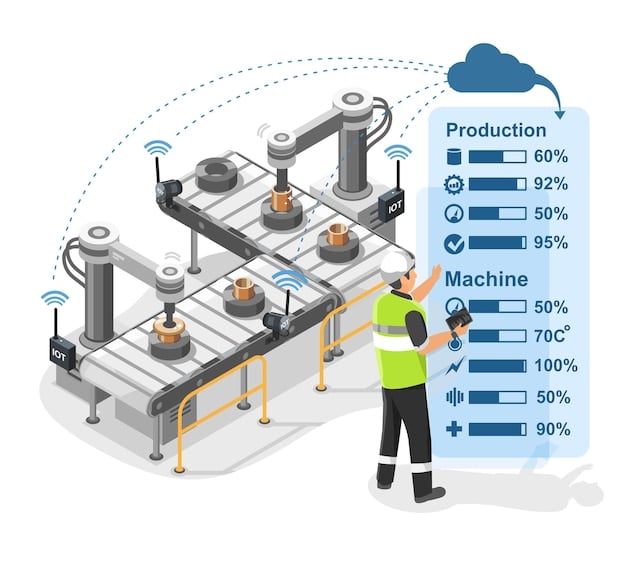
The accuracy of these algorithms depends on the quality and quantity of data available, as well as the expertise of the data scientists and engineers who develop and maintain them. As AI technology continues to advance, these algorithms are becoming more sophisticated and capable of providing even more accurate predictions.
Real-World Examples of Predictive Maintenance in US Plants
Several US manufacturing plants have already implemented **AI-powered predictive maintenance** with impressive results. These examples demonstrate the tangible benefits of adopting these technologies and provide valuable insights for other manufacturers considering implementation.
Case Study: Automotive Manufacturer
A leading automotive manufacturer implemented an AI-powered predictive maintenance system to monitor critical equipment in its assembly line. The system analyzes data from sensors on robotic arms, conveyors, and other equipment to predict failures before they occur. As a result, the manufacturer has reduced equipment downtime by 12% and saved millions of dollars in maintenance costs.
Case Study: Food Processing Plant
A food processing plant implemented a similar system to monitor its packaging equipment. The system analyzes data from sensors on filling machines, labeling machines, and sealing machines to predict failures and optimize maintenance schedules. This has resulted in a 15% reduction in downtime and a significant improvement in product quality.
These real-world examples demonstrate that AI-powered predictive maintenance can deliver significant benefits to US manufacturers in a variety of industries. By adopting these technologies, manufacturers can improve efficiency, reduce costs, and enhance their competitiveness.
Overcoming Challenges in AI Adoption in US Manufacturing
Despite the significant potential of **AI-powered predictive maintenance**, several challenges can hinder its adoption in US manufacturing. These include data quality issues, integration complexities, and skills gaps. Addressing these challenges is essential for realizing the full benefits of these technologies.
Data Quality Issues
AI algorithms rely on high-quality data to make accurate predictions. However, many manufacturers struggle with data quality issues, such as missing data, inaccurate data, and inconsistent data formats. Improving data quality is essential for ensuring the effectiveness of AI-powered predictive maintenance systems.
Integration Complexities
Integrating AI-powered predictive maintenance systems with existing manufacturing infrastructure can be complex and challenging. This often requires significant investment in software, hardware, and training. Manufacturers need to carefully plan and manage the integration process to ensure a successful implementation.
- Invest in data quality initiatives to ensure accurate and reliable data.
- Develop a comprehensive integration plan to seamlessly integrate AI systems.
- Provide training and education to address skills gaps and promote AI literacy.
By addressing these challenges proactively, US manufacturers can overcome barriers to AI adoption and unlock the full potential of these transformative technologies.
The Future of AI in US Manufacturing
The future of US manufacturing is inextricably linked to the continued advancement and adoption of **AI-powered predictive maintenance**. As AI technology continues to evolve, it is expected that these systems will become even more accurate, reliable, and accessible to manufacturers of all sizes.
Increased Automation
AI-powered predictive maintenance will enable increased automation in manufacturing processes. By automating maintenance tasks and optimizing equipment performance, manufacturers can reduce the need for human intervention and improve overall efficiency. This can lead to significant cost savings and increased productivity.
Greater Customization
AI can enable greater customization of manufacturing processes. By analyzing data on customer preferences and market trends, manufacturers can use AI to tailor their products and services to meet specific customer needs. This can lead to increased customer satisfaction and loyalty.
The future of US manufacturing is bright, with AI playing an increasingly important role in driving innovation, improving efficiency, and enhancing competitiveness. By embracing these technologies, US manufacturers can position themselves for success in the global marketplace.
| Key Point | Brief Description |
|---|---|
| ⚙️ Downtime Reduction | AI predicts failures, enabling timely maintenance and reducing downtime. |
| 💰 Cost Savings | Optimizes maintenance schedules, minimizing unnecessary interventions. |
| 📈 Efficiency Boost | Maximizes equipment utilization and operational efficiency. |
| 🛡️ Enhanced Safety | Prevents catastrophic failures for a safer work environment. |
FAQ
▼
It’s a proactive maintenance strategy using artificial intelligence to analyze equipment data, predict potential failures, and schedule maintenance before breakdowns occur, minimizing downtime and costs.
▼
AI algorithms analyze data from sensors, historical records, and other sources to identify patterns indicating potential failures. Machine learning models are trained to predict future breakdowns based on current conditions.
▼
The benefits include reduced downtime, lower maintenance costs, improved equipment utilization, enhanced safety, and increased overall efficiency in manufacturing operations through proactive interventions.
▼
Challenges include ensuring data quality, integrating AI systems with existing infrastructure, addressing skills gaps, and managing the complexities of analyzing and interpreting large volumes of data efficiently.
▼
By 2025, AI systems will be more accurate, reliable, and accessible, enabling increased automation, greater customization of manufacturing processes, and improved overall efficiency. They will become more integral to US manufacturing.
Conclusion
In conclusion, the integration of **AI-powered predictive maintenance** into US manufacturing is set to significantly reduce equipment downtime and optimize operational efficiency by 2025. By addressing existing challenges and embracing the advancements in AI technology, US manufacturers can unlock the full potential of these technologies, positioning themselves for enhanced competitiveness and success in the global marketplace.