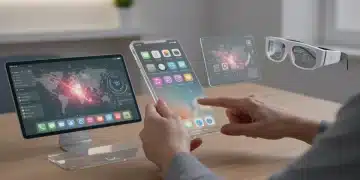
Are Augmented Reality Glasses Finally Practical in 2025?

Augmented Reality (AR) glasses are poised to transition from niche gadgets to practical everyday tools by 2025, driven by advancements in technology, improved user experience, and a growing range of applications across various industries and consumer needs.
Are we about to witness the true arrival of augmented reality glasses? The promise of seamlessly blending digital information with our physical world has been a tantalizing prospect for years. Are Augmented Reality Glasses: Are They Finally Becoming Practical for Everyday Use in 2025? Let’s dive into the technological advancements, potential applications, and lingering challenges that will determine whether 2025 is the year AR glasses finally go mainstream.
The Technological Leaps Making AR Glasses Viable
The practicality of augmented reality glasses hinges on significant technological advancements. Miniaturization, processing power, display technology, and battery life are all critical factors that have seen substantial improvements in recent years, making AR glasses more feasible for everyday use.
Advancements in Display Technology
One of the key hurdles in AR glasses development was creating displays that are both transparent and capable of projecting high-resolution images. Recent advancements in waveguide technology and micro-OLED displays have led to brighter, clearer, and more energy-efficient visuals. This allows AR glasses to provide a more immersive and comfortable viewing experience.
Improved Processing Power and AI Integration
Modern AR glasses require powerful processors to handle real-time image recognition, data processing, and interactive applications. The integration of AI and machine learning algorithms further enhances their capabilities, enabling features like object recognition, natural language processing, and personalized experiences. These advancements allow AR glasses to understand and respond to the user’s environment intelligently.

- Enhanced Visual Clarity: The latest AR glasses offer significantly improved resolution and brightness, making virtual content appear more vivid and realistic.
- AI-Powered Object Recognition: Advanced algorithms enable the glasses to identify objects and provide relevant information in real-time.
- Seamless Integration: New processors allow for smoother and more responsive interactions with digital content.
These technological advancements are paving the way for AR glasses that are not only more powerful but also more comfortable and user-friendly. As these technologies continue to evolve, we can expect even more impressive capabilities and a wider range of applications.
In summary, the dramatic advancements in display technology and processing power are making AR glasses increasingly viable for daily use. These improvements are crucial for delivering a seamless and compelling augmented reality experience.
Potential Everyday Applications of AR Glasses in 2025
The potential applications of augmented reality glasses extend far beyond gaming and entertainment. By 2025, AR glasses could become indispensable tools for various everyday tasks, from navigation and communication to productivity and education.
Navigation and Real-Time Information
Imagine walking through a city and having directions overlaid directly onto your field of vision. AR glasses can provide real-time navigation, displaying turn-by-turn instructions and points of interest without the need to constantly check your smartphone. Additionally, they can offer instant access to information about nearby landmarks, businesses, and public transportation.
Communication and Social Interaction
AR glasses can revolutionize the way we communicate and interact with others. They can facilitate hands-free video calls, display notifications and messages, and even translate languages in real-time. Imagine attending a meeting where the faces of participants are automatically identified, and their titles and backgrounds are displayed discreetly on your glasses.

- Hands-Free Navigation: AR glasses provide seamless turn-by-turn directions, enhancing mobility.
- Real-Time Translation: Instant language translation breaks down communication barriers during travel.
- Enhanced Productivity: AR can streamline workflows by providing contextual information and instructions.
These applications highlight the transformative potential of AR glasses in our daily routines. By seamlessly integrating digital information into our physical world, AR glasses can enhance our ability to explore, connect, and accomplish tasks more efficiently.
In conclusion, the diverse applications of AR glasses across navigation, communication, and productivity domains illustrate how they can become essential tools for everyday life. Their ability to provide real-time information and hands-free interaction positions them as a valuable asset in various scenarios.
Challenges and Obstacles to Mainstream Adoption
Despite the technological advancements and potential benefits, several challenges and obstacles still stand in the way of mainstream adoption of augmented reality glasses. Addressing these issues is crucial for AR glasses to truly become practical for everyday use in 2025.
Privacy Concerns and Data Security
One of the biggest concerns surrounding AR glasses is privacy. The ability of these devices to record and analyze the environment raises questions about data collection, storage, and usage. Ensuring robust data security and implementing transparent privacy policies will be essential to gain public trust and prevent misuse of personal information.
Ergonomics and Design Considerations
For AR glasses to be worn comfortably for extended periods, they need to be lightweight, well-balanced, and aesthetically appealing. Early versions of AR glasses were often bulky and cumbersome, making them impractical for everyday use. Ongoing efforts to miniaturize components and improve design are crucial to enhance user comfort and acceptance.
- Addressing Privacy: Implementing clear and robust privacy policies is paramount to build user confidence.
- Improving Comfort: Reducing weight and enhancing ergonomics will encourage extended wear.
- Cost Reduction: Making AR glasses more affordable will broaden their market appeal.
These challenges highlight the complexities of bringing AR glasses to the mainstream market. Overcoming these hurdles is essential for AR glasses to achieve widespread adoption and become a practical tool for everyday use.
In summary, the issues surrounding privacy, ergonomics, and cost represent significant barriers to the widespread adoption of AR glasses. Addressing these concerns is essential to ensure that AR technology becomes accessible and trustworthy for the general public.
The Role of 5G and Enhanced Connectivity
The performance and functionality of augmented reality glasses are heavily reliant on fast and reliable internet connectivity. The rollout of 5G networks and other advanced communication technologies is poised to play a crucial role in unlocking the full potential of AR glasses.
Low Latency and High Bandwidth
5G networks offer significantly lower latency and higher bandwidth compared to previous generations of wireless technology. This enables AR glasses to stream high-resolution content, process data in real-time, and interact with cloud-based services seamlessly. The improved connectivity enhances the overall user experience and expands the range of possible applications.
Edge Computing and Distributed Processing
Edge computing, which involves processing data closer to the source, can further enhance the performance of AR glasses by reducing latency and minimizing the reliance on cloud servers. By distributing processing tasks between the glasses and nearby edge servers, AR applications can run more efficiently and respond more quickly to user interactions.
- Real-Time Data Streaming: 5G facilitates uninterrupted streaming of high-resolution augmented reality content.
- Improved Responsiveness: Low latency ensures quick and seamless interactions with digital interfaces.
- Enhanced Mobility: Reliable connectivity supports AR applications in diverse locations and scenarios.
The combination of 5G connectivity and edge computing is set to transform the capabilities of AR glasses, making them more versatile and practical for a wide range of applications. As these technologies continue to evolve, we can expect even more innovative and immersive AR experiences.
In conclusion, the deployment of 5G networks and the rise of edge computing are pivotal in enhancing the performance and practicality of AR glasses. These advancements enable faster data processing, lower latency, and improved overall user experience.
Consumer Perception and Market Trends
The success of augmented reality glasses ultimately depends on consumer perception and market trends. Understanding how consumers view AR technology and identifying key market trends are crucial for developers and manufacturers to create products that resonate with the target audience.
Growing Interest in Immersive Experiences
Consumers are increasingly seeking immersive experiences that blur the lines between the physical and digital worlds. This trend is driving demand for AR and VR technologies, with many consumers expressing interest in exploring the potential of AR glasses for entertainment, productivity, and social interaction. As AR technology continues to improve, we can expect even greater consumer adoption.
Early Adopters and Niche Markets
While mainstream adoption of AR glasses may still be a few years away, early adopters and niche markets are already driving demand for these devices. Industries such as healthcare, manufacturing, and logistics are investing in AR solutions to improve efficiency, productivity, and training. These early use cases are helping to pave the way for broader consumer adoption.
- Increasing Interest: Consumer interest in immersive digital experiences is growing rapidly.
- Niche Market Growth: AR adoption in healthcare, manufacturing, and logistics is expanding.
- Price Sensitivity: Affordability is key to overcoming consumer hesitation and encouraging adoption.
By understanding consumer sentiments and leveraging key market trends, developers and manufacturers can create AR glasses that meet the needs and expectations of the target audience. This will be essential for driving widespread adoption and establishing AR glasses as a practical tool for everyday use.
In summary, consumer perception and market trends play a pivotal role in the success of AR glasses. Growing interest in immersive experiences and the expansion of niche markets are driving demand, while addressing concerns about cost and usability will be crucial for mainstream adoption.
Future Outlook and Projections for 2025 and Beyond
Looking ahead to 2025 and beyond, the future of augmented reality glasses appears promising. As technology continues to advance and consumer acceptance grows, AR glasses are poised to become an integral part of our daily lives, transforming the way we work, communicate, and interact with the world around us.
Continued Innovation and Development
Ongoing research and development efforts are focused on improving the performance, functionality, and usability of AR glasses. We can expect to see further advancements in display technology, processing power, battery life, and AI integration, leading to more immersive and seamless AR experiences. These innovations will pave the way for new applications and use cases that were previously unimaginable.
Integration with Other Technologies
AR glasses are likely to become increasingly integrated with other technologies, such as smartphones, smart homes, and wearable devices. This integration will enable seamless data sharing and synchronization, creating a more connected and personalized user experience. Imagine using your AR glasses to control your smart home devices, access your health data, and communicate with friends and family, all from a single device.
- Technological Advancements: Continued innovation will enhance the capabilities and usability of AR glasses.
- Seamless Integration: AR glasses are likely to integrate with other devices and platforms to offer a more streamlined user experience.
- Widespread Adoption: As AR technology becomes more accessible and affordable, we can expect to see increased adoption across various sectors.
The potential of augmented reality glasses is vast, and their impact on society is likely to be profound. As we move closer to 2025 and beyond, we can anticipate exciting developments and transformative applications that will reshape the way we live and work.
In conclusion, the future outlook for AR glasses is bright, with continued innovation, integration with other technologies, and increasing adoption on the horizon. As AR technology evolves, these devices are poised to become indispensable tools in our daily lives.
| Key Feature | Brief Description |
|---|---|
| 🚀 Enhanced Navigation | Real-time, hands-free directions projected onto your view. |
| 🌐 Instant Translation | Communicate seamlessly in any language with real-time translation. |
| 🔒 Privacy Concerns | Addressing data security and privacy policies is crucial for adoption. |
| 📱 5G Connectivity | Reliable, high-speed internet is vital for optimal performance. |
Frequently Asked Questions (FAQ)
▼
Key advancements include improved display technology (micro-OLED, waveguides), more powerful processors, AI integration for object recognition, and better battery life, making AR glasses more practical.
▼
AR glasses can provide real-time navigation, facilitate hands-free communication, offer instant language translation, and enhance productivity by providing contextual information and instructions.
▼
Challenges include addressing privacy concerns, improving ergonomics and design for comfort, and reducing costs to make AR glasses more affordable for the general public.
▼
5G provides lower latency and higher bandwidth, enabling AR glasses to stream high-resolution content, process data in real-time, and interact with cloud-based services seamlessly, enhancing the user experience.
▼
AR glasses are expected to continue innovating with improved technology and greater integration with other devices, leading to more personalized and connected user experiences and widespread adoption.
Conclusion
In conclusion, augmented reality glasses are on the cusp of becoming practical for everyday use by 2025, driven by technological advancements in display technology, processing power, and 5G connectivity. While challenges related to privacy, ergonomics, and cost remain, the growing interest in immersive experiences and the expansion of niche markets suggest a promising future for AR glasses as an integral part of our daily lives.