Augmented Reality Glasses: Ready for Everyday Use in 2025? A Review

Augmented Reality (AR) glasses are rapidly evolving, and by 2025, advancements in technology, design, and software may make them a viable and practical tool for everyday use, enhancing various aspects of daily life.
Are Augmented Reality Glasses: Are They Ready for Everyday Use in 2025? An In-Depth Review finally poised to become the next must-have gadget? Let’s explore the possibilities and challenges ahead!
What are Augmented Reality (AR) Glasses?
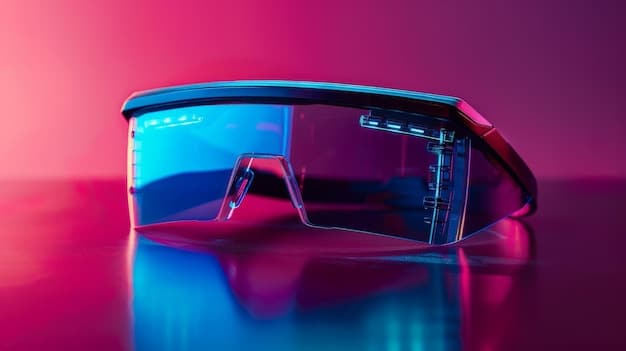
Augmented reality (AR) glasses represent a cutting-edge technology designed to overlay digital information onto the real world. Unlike virtual reality (VR), which immerses users in a completely digital environment, AR enhances the user’s existing surroundings with computer-generated images, text, and other data. This technology has the potential to transform how we interact with our environment and conduct various tasks.
Key Components and Functionality
AR glasses typically consist of several key components that work together to deliver a seamless augmented reality experience. These include displays, sensors, processors, and connectivity features. The display technology projects digital information onto the lenses, allowing users to see virtual content superimposed on their view of the real world. Sensors, such as cameras and accelerometers, track the user’s movements and environment, enabling the AR system to accurately align virtual content with the real world. High-performance processors are essential for handling complex calculations and rendering lifelike graphics. Finally, connectivity features, such as Wi-Fi and Bluetooth, allow the glasses to connect to the internet and other devices, enabling real-time data streaming and interactive experiences.
How AR Glasses Differ from VR Headsets
While both AR glasses and VR headsets offer immersive experiences, they differ significantly in their approach. VR headsets create completely virtual environments, blocking out the user’s view of the real world. AR glasses, on the other hand, augment the user’s reality by overlaying digital content onto their existing surroundings. This distinction makes AR glasses more suitable for everyday use, as users can remain aware of their physical environment while still benefiting from digital enhancements. VR headsets are better suited for gaming, simulations, and other applications where complete immersion is desired.
- Virtual Reality (VR): Creates a completely immersive, digital environment.
- Augmented Reality (AR): Overlays digital information onto the real world.
- Mixed Reality (MR): Blends physical and digital worlds, allowing for interactions with virtual objects.
In summary, augmented reality glasses are a sophisticated technology that combines digital information with the real world, offering a unique blend of immersive and practical functionality. Understanding their key components and how they differ from VR headsets is crucial for appreciating their potential impact on everyday life.
The Current State of AR Glasses Technology
The development of augmented reality (AR) glasses has seen significant advancements in recent years, with several major players investing heavily in research and development. These advancements have led to improvements in display technology, processing power, and sensor capabilities, making AR glasses more practical and user-friendly.
Key Players in the AR Glasses Market
Several companies are at the forefront of the AR glasses market, including tech giants like Apple, Meta (formerly Facebook), Microsoft, and Google. Each company brings its unique expertise and vision to the table, contributing to the rapid evolution of AR technology. Apple is rumored to be developing AR glasses that seamlessly integrate with its ecosystem of devices, while Meta is focused on creating AR glasses that enhance social interactions. Microsoft’s HoloLens is already being used in enterprise settings for training and remote assistance, and Google is exploring new applications for AR through its Glass Enterprise Edition.
Notable AR Glasses Models Available Today
While widespread consumer adoption is still on the horizon, several AR glasses models are currently available for purchase, targeting specific use cases and industries. The Microsoft HoloLens 2 is a high-end AR headset designed for enterprise applications, offering advanced features such as hand tracking and spatial mapping. The Magic Leap 2 is another enterprise-focused AR headset, known for its high-quality display and comfortable design. For consumers, the Nreal Air offers a more affordable and lightweight AR experience, primarily focused on media consumption and gaming. These models represent the current state of AR glasses technology, showcasing the potential for future advancements.
- Microsoft HoloLens 2: Advanced AR headset for enterprise applications.
- Magic Leap 2: High-quality display and comfortable design for professional use.
- Nreal Air: Affordable and lightweight AR glasses for media consumption and gaming.
In conclusion, the current state of AR glasses technology is marked by significant progress and ongoing development. Key players in the market are pushing the boundaries of what’s possible, leading to innovative models that cater to various needs and industries. While challenges remain, the future of AR glasses looks promising, with the potential for widespread adoption in the years to come.
Improvements Needed for Everyday Use
While augmented reality (AR) glasses have made significant strides, several key improvements are necessary before they can become widely adopted for everyday use. These improvements span various aspects of the technology, including design, battery life, software, and affordability.
Design and Comfort
One of the primary barriers to everyday use is the design and comfort of current AR glasses. Many models are bulky and heavy, making them uncomfortable to wear for extended periods. Future AR glasses need to be more lightweight and ergonomic, resembling traditional eyewear in terms of size and appearance. Additionally, customizable options and adjustable features are essential to accommodate a wide range of users.
Battery Life and Performance
Battery life is another critical factor that needs improvement. Current AR glasses often suffer from limited battery life, which can be a major inconvenience for users who want to use them throughout the day. Additionally, performance issues such as lag and overheating can detract from the overall user experience. Future AR glasses need to offer longer battery life and more efficient performance to meet the demands of everyday use. This requires advancements in battery technology and more efficient processor design.
Software and User Interface
The software and user interface of AR glasses must be intuitive and user-friendly for mass adoption. Current AR interfaces can be clunky and difficult to navigate, requiring users to learn complex gestures and commands. Future AR glasses need to offer more natural and seamless interactions, such as voice control, eye tracking, and gesture recognition. A robust app ecosystem is also essential, providing users with a wide range of applications and content to choose from.

- Design and Comfort: Lightweight, ergonomic, and customizable.
- Battery Life: Longer battery life for all-day use.
- Software: Intuitive user interface and robust app ecosystem.
- Affordability: Competitive pricing for mass adoption.
In summary, several key improvements are needed before augmented reality glasses can become a mainstream technology for everyday use. Addressing issues related to design, battery life, software, and affordability is crucial for creating AR glasses that are practical, user-friendly, and appealing to a wide range of consumers.
Potential Everyday Applications in 2025
By 2025, augmented reality (AR) glasses have the potential to transform various aspects of everyday life, offering innovative solutions for navigation, communication, entertainment, and productivity. These applications could significantly enhance how people interact with their environment and conduct daily tasks.
Navigation and Wayfinding
AR glasses can provide real-time navigation and wayfinding assistance, overlaying directions and points of interest onto the user’s view of the real world. This technology can be particularly useful for navigating unfamiliar cities or large indoor spaces such as airports and shopping malls. AR navigation can offer turn-by-turn directions, highlight landmarks, and provide information about nearby businesses and attractions, making it easier for users to reach their destinations quickly and efficiently.
Communication and Social Interaction
AR glasses can enhance communication and social interaction by providing hands-free access to messaging, video calls, and social media. Users can receive notifications, respond to messages, and participate in video calls without having to take out their smartphones. AR glasses can also overlay information about people nearby, such as their names, job titles, and social media profiles, making it easier to connect with others and build relationships.
Entertainment and Gaming
AR glasses can offer immersive entertainment and gaming experiences, overlaying virtual content onto the user’s real-world environment. Users can watch movies, play games, and experience interactive stories in a whole new way. AR gaming can transform any physical space into a virtual playground, allowing users to interact with virtual characters and objects in their own homes or neighborhoods. This technology has the potential to revolutionize the entertainment industry, offering new and exciting ways to consume content and engage with others.
Productivity and Information Access
AR glasses can enhance productivity and information access by providing hands-free access to data, documents, and applications. Users can view emails, edit documents, and access real-time information without having to look at a computer screen or smartphone. AR glasses can also provide on-the-job training and remote assistance, guiding workers through complex tasks and providing them with the information they need to perform their jobs effectively. This technology has the potential to transform various industries, including manufacturing, healthcare, and education.
In conclusion, by 2025, augmented reality glasses have the potential to offer a wide range of everyday applications, transforming how people navigate, communicate, entertain themselves, and work. While challenges remain, the future of AR glasses looks promising, with the potential to revolutionize various aspects of daily life.
Challenges and Obstacles to Adoption
Despite the potential benefits of augmented reality (AR) glasses, several challenges and obstacles stand in the way of widespread adoption. These challenges include technological limitations, privacy concerns, high costs, and lack of compelling use cases.
Technological Limitations
One of the primary obstacles to adoption is the current technological limitations of AR glasses. Issues such as limited battery life, bulky designs, and performance limitations can detract from the user experience and make AR glasses less appealing for everyday use. Overcoming these limitations requires ongoing research and development in areas such as battery technology, display technology, and processor design. Additionally, improving the accuracy and reliability of AR tracking and image recognition is essential for creating a seamless and immersive user experience.
Privacy Concerns
Privacy concerns are another significant barrier to adoption. AR glasses have the potential to collect and transmit vast amounts of personal data, raising concerns about surveillance, data security, and unauthorized access. Addressing these concerns requires robust privacy safeguards, such as encryption, data anonymization, and user consent. Additionally, clear and transparent privacy policies are essential for building trust with users and ensuring that their data is protected.
Cost and Affordability
The high cost of AR glasses is another obstacle to widespread adoption. Current AR glasses models can cost several thousand dollars, making them unaffordable for most consumers. Lowering the cost of AR glasses requires economies of scale, technological innovation, and increased competition. Additionally, offering financing options and subscription models can make AR glasses more accessible to a wider range of consumers.
Lack of Compelling Use Cases
Finally, the lack of compelling use cases is a significant barrier to adoption. Many consumers are unsure of how AR glasses would benefit them in their daily lives, making it difficult to justify the cost and potential privacy risks. Developing killer apps and compelling use cases is essential for driving demand and demonstrating the value of AR glasses. These use cases should address specific needs and pain points, offering tangible benefits that outweigh the potential drawbacks.
- Technological Limitations: Improving battery life, design, and performance.
- Privacy Concerns: Implementing robust privacy safeguards and transparent policies.
- Cost: Lowering the cost through economies of scale and innovation.
- Use Cases: Developing compelling applications that demonstrate value.
In summary, several challenges and obstacles stand in the way of widespread adoption of augmented reality glasses. Overcoming these challenges requires a concerted effort from researchers, developers, policymakers, and consumers.
Predictions for AR Glasses in 2025
Looking ahead to 2025, several predictions can be made about the future of augmented reality (AR) glasses based on current trends and technological advancements. These predictions span various aspects of the technology, including design, functionality, and market adoption.
Improved Design and Ergonomics
By 2025, AR glasses are likely to feature improved design and ergonomics, becoming more lightweight and comfortable to wear. This will involve the use of advanced materials, such as carbon fiber and lightweight plastics, as well as innovative design techniques that minimize bulk and maximize comfort. AR glasses may also incorporate modular designs, allowing users to customize their appearance and functionality based on their individual preferences.
Enhanced Battery Life and Performance
Significant advancements in battery technology and processor design are expected to lead to enhanced battery life and performance in AR glasses by 2025. New battery technologies, such as solid-state batteries and wireless charging, may enable AR glasses to last for an entire day on a single charge. Additionally, more efficient processors and optimized software can improve performance and reduce lag, providing a smoother and more responsive user experience.
Integration with AI and 5G
Integration with artificial intelligence (AI) and 5G networks is likely to be a key feature of AR glasses in 2025. AI can enhance various aspects of the AR experience, such as object recognition, voice control, and personalized content recommendations. 5G connectivity can enable faster data transfer rates and lower latency, allowing for more immersive and interactive AR experiences. This integration can unlock new possibilities for AR applications in areas such as education, healthcare, and entertainment.
Increased Consumer Adoption
While challenges remain, increased consumer adoption of AR glasses is expected by 2025 as the technology becomes more affordable, user-friendly, and compelling. Key factors driving adoption will include the development of killer apps, the availability of more affordable models, and increased awareness among consumers. As AR glasses become more integrated into daily life, they are likely to become an essential tool for communication, information access, and entertainment.
In summary, the future of augmented reality glasses looks promising, with several key predictions for 2025. Improved design, enhanced battery life, integration with AI and 5G, and increased consumer adoption are all likely to shape the future of AR glasses and their impact on everyday life.
| Key Point | Brief Description |
|---|---|
| 👓 AR Glasses | Overlay digital info onto the real world. |
| 🔋 Battery Life | Needs improvement for all-day use. |
| 🛡️ Privacy | Key concern; needs robust safeguards. |
| 💰 Affordability | Cost needs to decrease for mass adoption. |
Frequently Asked Questions
▼
AR glasses overlay digital information onto the real world, while VR glasses create fully immersive digital environments, blocking out the real world. AR is for augmenting reality, VR is for replacing it.
▼
AR glasses could be used for navigation, communication, entertainment, and productivity. Imagine hands-free directions, instant information access, and immersive gaming experiences all in your view.
▼
Key challenges include technological limitations (battery life, design), privacy concerns, high cost, and the lack of compelling “killer apps” that demonstrate their everyday usefulness.
▼
Improvements are expected in design (more comfortable and stylish), battery life, and performance thanks to advancements in technology and integration with AI and faster 5G networks.
▼
Privacy is a major concern. Implementing strong data protection, encryption, and clear user policies is crucial to ensure safe use and build trust with consumers.
Conclusion
In conclusion, while augmented reality glasses hold immense potential to revolutionize various aspects of our lives by 2025, significant hurdles remain. Overcoming technological limitations, addressing privacy concerns, reducing costs, and developing compelling use cases are crucial steps towards achieving widespread adoption. The journey is ongoing, but the future of AR glasses looks promising and transformative.