Demystifying Machine Learning: A 2026 Guide to Core Algorithms and Their Business Applications in the US

Demystifying Machine Learning: A 2026 Guide to Core Algorithms and Their Business Applications in the US
Understanding the foundational machine learning algorithms is no longer a niche skill but a fundamental requirement for navigating the modern business landscape. In 2026, the United States continues to lead in adopting these transformative technologies, driving innovation across every sector. This comprehensive guide will demystify the core machine learning algorithms, exploring their mechanisms and illustrating their profound impact on US businesses.
The pace of technological advancement is relentless, and at its heart lies machine learning – a subset of artificial intelligence that empowers systems to learn from data, identify patterns, and make decisions with minimal human intervention. For businesses in the US, leveraging these capabilities is not just an advantage; it’s a necessity for staying competitive, optimizing operations, and uncovering new opportunities. From Silicon Valley startups to established industrial giants, the application of machine learning algorithms is reshaping industries and redefining what’s possible.
The Foundational Pillars: Understanding Machine Learning Paradigms
Before diving into specific machine learning algorithms, it’s crucial to grasp the three primary learning paradigms that categorize how these algorithms learn and operate. These paradigms dictate the type of problems machine learning can solve and the kind of data required.
Supervised Learning: Learning from Labeled Data
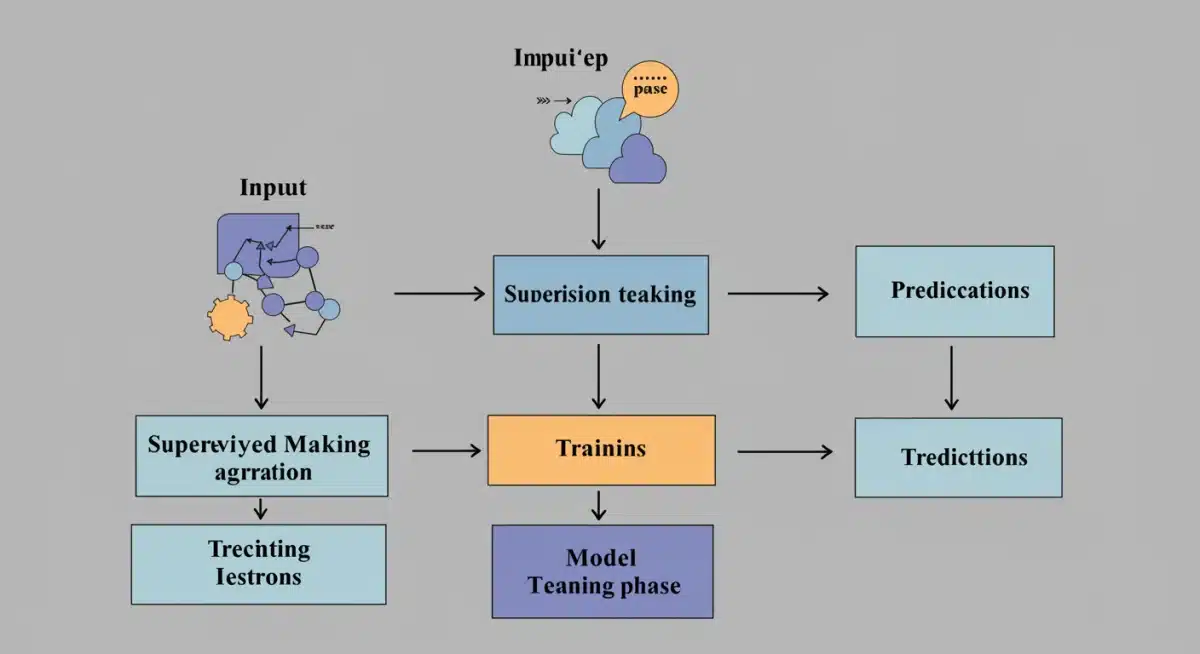
Supervised learning is arguably the most common and accessible form of machine learning. It involves training a model on a labeled dataset, meaning each piece of input data is paired with its correct output. The algorithm learns by finding patterns that map the inputs to the outputs, and then uses this learned mapping to predict outcomes for new, unseen data. Think of it like a student learning from a teacher who provides both questions and answers. Once the student understands the relationship, they can answer new questions independently.
Key Supervised Machine Learning Algorithms:
- Linear Regression: This algorithm is used for predicting continuous numerical values. For example, predicting house prices based on features like size, location, and number of bedrooms. In US real estate, linear regression models help appraisers and buyers estimate property values, providing crucial insights for investment and sales strategies.
- Logistic Regression: Despite its name, logistic regression is a classification algorithm used for predicting categorical outcomes (e.g., yes/no, true/false). It’s widely used in US finance for credit scoring (predicting loan default risk) or in marketing for predicting customer churn.
- Decision Trees: These algorithms make decisions by breaking down data into smaller and smaller subsets based on a series of questions. They are intuitive and easy to interpret. US healthcare providers might use decision trees to diagnose diseases based on symptoms, or in retail for customer segmentation.
- Random Forest: An ensemble learning method that builds multiple decision trees and merges their predictions to get a more accurate and stable prediction. This is particularly effective for complex datasets and is employed in fraud detection within US banking and insurance.
- Support Vector Machines (SVMs): SVMs are powerful for classification and regression tasks. They work by finding the optimal hyperplane that separates data points into different classes. They are often used in image recognition and text classification, such as identifying spam emails for US businesses.
- K-Nearest Neighbors (KNN): A non-parametric, lazy learning algorithm used for both classification and regression. It classifies a data point based on the majority class of its ‘K’ nearest neighbors. In US e-commerce, KNN can power recommendation engines, suggesting products to customers based on similar users’ purchasing habits.
Business Applications of Supervised Learning in the US:
- Predictive Analytics: Forecasting sales, predicting stock market trends, or anticipating equipment failures in manufacturing.
- Customer Relationship Management (CRM): Identifying valuable customers, predicting customer lifetime value, and personalizing marketing campaigns.
- Fraud Detection: Flagging suspicious transactions in financial services or identifying fraudulent insurance claims.
- Healthcare Diagnostics: Assisting doctors in diagnosing diseases, predicting patient outcomes, and optimizing treatment plans.
- Quality Control: Detecting defects in manufacturing processes, ensuring product quality and reducing waste.
Unsupervised Learning: Discovering Hidden Patterns
Unlike supervised learning, unsupervised learning deals with unlabeled data. The goal here is to discover hidden patterns, structures, or relationships within the data without any prior knowledge of the output. It’s like giving a student a large collection of books and asking them to organize them into categories based on their content, without any predefined categories. This approach is invaluable for exploratory data analysis and for tasks where labeling data is impractical or impossible.
Key Unsupervised Machine Learning Algorithms:
- Clustering (K-Means, Hierarchical Clustering, DBSCAN): Clustering algorithms group similar data points together. K-Means is one of the most popular, partitioning data into ‘K’ clusters where each data point belongs to the cluster with the nearest mean. US retail companies use clustering to segment customers into distinct groups based on purchasing behavior, allowing for highly targeted marketing strategies.
- Dimensionality Reduction (Principal Component Analysis – PCA): PCA is used to reduce the number of variables in a dataset while retaining as much information as possible. This simplifies complex datasets, making them easier to analyze and visualize. In US scientific research, PCA can help analyze high-dimensional genomic data to identify key genetic markers.
- Association Rule Learning (Apriori): This algorithm identifies strong relationships between items in large datasets. It’s famously used for market basket analysis. US supermarkets use Apriori to discover which products are frequently bought together, influencing store layout and promotional offers (e.g., ‘customers who bought diapers also bought baby wipes’).
- Autoencoders: A type of neural network used for learning efficient data codings in an unsupervised manner. They are powerful for dimensionality reduction and anomaly detection. In cybersecurity for US enterprises, autoencoders can identify unusual network traffic patterns that might indicate a cyberattack.
Business Applications of Unsupervised Learning in the US:
- Customer Segmentation: Grouping customers based on demographics, behavior, or preferences for personalized marketing.
- Anomaly Detection: Identifying unusual patterns that could indicate fraud, system failures, or security breaches.
- Recommendation Systems: Grouping similar items or users to suggest products, movies, or content.
- Data Compression: Reducing the complexity of large datasets for more efficient storage and processing.
- Topic Modeling: Discovering abstract ‘topics’ that occur in a collection of documents, useful for analyzing customer feedback or news articles.
Reinforcement Learning: Learning Through Interaction
Reinforcement learning (RL) is a paradigm where an agent learns to make decisions by interacting with an environment. The agent receives rewards for desirable actions and penalties for undesirable ones, eventually learning a policy that maximizes cumulative reward. This is analogous to how humans learn through trial and error. RL has seen significant breakthroughs in recent years, particularly in areas like game playing and robotics.
Key Reinforcement Machine Learning Algorithms:
- Q-Learning: A model-free reinforcement learning algorithm that learns the value of an action in a particular state. It doesn’t require a model of the environment and can handle problems with stochastic transitions and rewards.
- SARSA (State-Action-Reward-State-Action): Similar to Q-learning, but SARSA is an on-policy learning algorithm, meaning it learns the value of the action taken according to the current policy.
- Deep Q-Networks (DQNs): Combines Q-learning with deep neural networks, allowing RL agents to learn from high-dimensional sensory input, like raw pixels from a game screen.
- Policy Gradient Methods: Algorithms that directly learn a policy that maps states to actions, often used in continuous action spaces.
- Actor-Critic Methods: These methods combine elements of both value-based (critic) and policy-based (actor) approaches, often leading to more stable and efficient learning.
Business Applications of Reinforcement Learning in the US:
- Robotics and Automation: Training robots to perform complex tasks in manufacturing, logistics, and healthcare.
- Autonomous Vehicles: Developing self-driving car systems that learn to navigate and make decisions in real-time.
- Resource Management: Optimizing energy consumption in data centers or managing complex supply chain logistics.
- Financial Trading: Developing automated trading strategies that adapt to market conditions.
- Personalized Recommendations (Advanced): Creating highly dynamic and adaptive recommendation systems that learn from user interactions over time.
Deep Learning: The Power of Neural Networks
Deep learning is a specialized subset of machine learning that uses artificial neural networks with multiple layers (hence ‘deep’) to learn from vast amounts of data. Inspired by the human brain’s structure, deep learning models can automatically discover intricate patterns and representations from raw data, often outperforming traditional machine learning algorithms in tasks involving images, speech, and natural language.
Key Deep Learning Algorithms and Architectures:
- Convolutional Neural Networks (CNNs): Primarily used for image and video analysis. CNNs automatically learn spatial hierarchies of features, making them incredibly effective for tasks like image classification, object detection, and facial recognition. US companies in autonomous driving and medical imaging rely heavily on CNNs.
- Recurrent Neural Networks (RNNs) & Long Short-Term Memory (LSTMs): Designed for sequential data, such as text and time series. RNNs and LSTMs have ‘memory’ and can process sequences of inputs, making them ideal for natural language processing (NLP) tasks, speech recognition, and machine translation. US tech giants use these for virtual assistants and predictive text.
- Generative Adversarial Networks (GANs): Consist of two neural networks, a generator and a discriminator, that compete against each other to generate new, realistic data. GANs are used for creating synthetic images, videos, and even text, finding applications in creative industries and data augmentation for training other models.
- Transformers: A groundbreaking architecture that excels in NLP tasks, particularly for machine translation and text generation. Transformers have revolutionized large language models (LLMs) and are at the core of advanced AI chatbots and content creation tools used by US businesses.
Business Applications of Deep Learning in the US:
- Natural Language Processing (NLP): Powering chatbots, sentiment analysis, language translation, and intelligent document processing.
- Computer Vision: Facial recognition for security, autonomous vehicle navigation, medical image analysis, and quality inspection in manufacturing.
- Speech Recognition: Enabling voice assistants, transcribing audio, and analyzing customer service calls.
- Drug Discovery: Accelerating the identification of new drug candidates and understanding complex biological interactions.
- Personalized Content Creation: Generating tailored marketing content, product descriptions, and even news articles.

The Synergy of Algorithms: How Businesses Combine ML Approaches
In reality, businesses rarely rely on a single machine learning algorithm. Instead, they often combine different approaches to solve complex problems. For instance, a retail company might use unsupervised clustering to segment customers, then apply supervised classification to predict which segment is most likely to respond to a particular promotion. Reinforcement learning could then optimize the timing and content of these promotions based on real-time customer engagement.
The key to successful implementation lies in understanding the strengths and weaknesses of each algorithm and knowing when and how to integrate them effectively. Data scientists and ML engineers in the US are constantly innovating, developing hybrid models and advanced pipelines that leverage the best of each paradigm.
Challenges and Ethical Considerations in the US Machine Learning Landscape
While the potential of machine learning algorithms is immense, their deployment also brings significant challenges and ethical considerations, particularly in the US context:
- Data Privacy and Security: With vast amounts of data being processed, protecting sensitive information and complying with regulations like CCPA (California Consumer Privacy Act) and emerging federal data privacy laws is paramount.
- Bias and Fairness: ML models can inherit and amplify biases present in their training data, leading to unfair or discriminatory outcomes. Addressing algorithmic bias in areas like hiring, lending, and criminal justice is a critical focus for US policymakers and researchers.
- Interpretability and Explainability (XAI): Many advanced models, especially deep neural networks, are often considered ‘black boxes.’ Understanding why an algorithm makes a particular decision is crucial for trust, accountability, and debugging, especially in high-stakes applications like healthcare and autonomous systems.
- Regulatory Landscape: The US is actively grappling with how to regulate AI and machine learning. Proposed frameworks and ethical guidelines are emerging to ensure responsible development and deployment, impacting businesses across all sectors.
- Talent Gap: The demand for skilled machine learning engineers, data scientists, and AI ethicists continues to outpace supply in the US, creating a competitive talent market and a need for robust educational initiatives.
The Future of Machine Learning in the US (2026 and Beyond)
As we look towards 2026 and beyond, the evolution of machine learning algorithms will be characterized by several key trends:
- Edge AI: More ML processing will happen closer to the data source (on devices like smartphones, sensors, and IoT devices), reducing latency and improving privacy.
- Automated Machine Learning (AutoML): Tools that automate parts of the ML pipeline, from data preprocessing to model selection and hyperparameter tuning, will become more sophisticated, democratizing AI development.
- Foundation Models and Generative AI: Large, pre-trained models capable of performing a wide range of tasks will continue to advance, enabling new applications in content creation, design, and scientific discovery.
- Hybrid AI: The combination of symbolic AI (rule-based systems) with statistical ML will lead to more robust and explainable AI systems.
- Ethical AI by Design: A greater emphasis will be placed on building ethical considerations, fairness, and transparency directly into the design and deployment of ML systems from the outset.
- Quantum Machine Learning: While still in its nascent stages, quantum computing holds the promise of accelerating certain ML algorithms, potentially unlocking solutions to currently intractable problems.
US businesses that proactively embrace these trends and invest in understanding and implementing advanced machine learning algorithms will be best positioned to thrive in the increasingly data-driven economy.
Conclusion: Empowering US Businesses with Machine Learning
The journey through the landscape of machine learning algorithms reveals a powerful toolkit for innovation and transformation. From the predictive power of supervised learning to the pattern-discovery capabilities of unsupervised methods, the adaptive intelligence of reinforcement learning, and the revolutionary advancements of deep learning, these algorithms are not just theoretical constructs; they are the engines driving tangible business value across the United States.
For executives, data professionals, and aspiring innovators in the US, a solid understanding of these core algorithms is indispensable. It empowers strategic decision-making, fosters the development of cutting-edge products and services, and ensures that businesses can navigate the complexities of the digital age with confidence. As 2026 unfolds, the continued mastery and ethical deployment of machine learning will be the hallmark of leading enterprises, shaping a future where data-driven intelligence fuels unprecedented growth and societal benefit.