The Future of Home Audio: Immersive Sound Systems and Spatial Audio
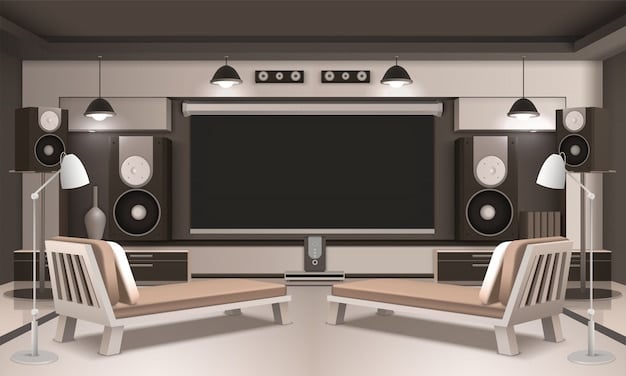
The Future of Home Audio: Immersive Sound Systems and Spatial Audio Explained explores the advancements in sound technology, creating a more realistic and engaging listening experience through spatial audio formats and sophisticated home audio systems.
The realm of sound is constantly evolving, and the future of home audio: immersive sound systems and spatial audio explained promises a revolution in how we experience music, movies, and games within the comfort of our homes. Prepare to dive into a new dimension of sonic fidelity.
Understanding Immersive Sound Systems
Immersive sound systems represent a significant leap forward from traditional stereo or even surround sound setups. These systems aim to create a more realistic and enveloping audio experience, making you feel like you’re right in the middle of the action.
Key Components of Immersive Sound
An immersive sound system typically consists of multiple speakers strategically placed around a listening area. These speakers work in concert to deliver sound from various directions, creating a three-dimensional soundscape.
Popular Immersive Sound Technologies
Dolby Atmos, DTS:X, and Auro-3D are among the leading immersive sound technologies. Each format employs unique algorithms and speaker configurations to achieve a heightened sense of realism and depth.
- Dolby Atmos: Adds height channels to create a more three-dimensional sound experience.
- DTS:X: Object-based audio that adapts to any speaker configuration.
- Auro-3D: Uses a layered approach to create a natural and realistic sound field.
Immersive sound systems are transforming home entertainment by providing a more engaging and dynamic listening experience. As technology continues to advance, we can expect even more sophisticated and realistic immersive sound solutions.
The Rise of Spatial Audio
Spatial audio is another key innovation shaping the future of home audio. Unlike traditional audio formats that focus on channel-based delivery, spatial audio aims to recreate the way we naturally perceive sound in the real world.
What is Spatial Audio?
Spatial audio uses advanced algorithms to place sounds in a three-dimensional space, taking into account factors like distance, direction, and environmental reflections. This creates a more realistic and immersive listening experience.
How Spatial Audio Works
Spatial audio technologies often rely on head-tracking and binaural processing to create a personalized listening experience. By tracking the listener’s head movements, the system can dynamically adjust the sound to maintain a consistent spatial image.
Spatial audio offers a more natural and immersive listening experience by recreating the way we perceive sound in the real world. As spatial audio becomes more prevalent, we can expect to see it integrated into a wide range of devices and applications.
Key Differences: Immersive Sound vs. Spatial Audio
While both immersive sound and spatial audio aim to enhance the listening experience, they approach the problem from different angles. Immersive sound focuses on speaker placement and channel-based delivery, while spatial audio emphasizes object-based rendering and binaural processing.
Technology and Approach
Immersive sound technologies like Dolby Atmos and DTS:X rely on specific speaker configurations and encoding techniques. Spatial audio, on the other hand, uses advanced algorithms to create a three-dimensional soundscape, often without the need for specialized hardware.
Hardware and Software
Immersive sound typically requires a dedicated home theater system with multiple speakers and a compatible receiver. Spatial audio can be enjoyed on a wider range of devices, including headphones, smartphones, and smart speakers, thanks to its software-based approach.
- Immersive Sound: Requires specific speaker setups and receivers.
- Spatial Audio: Can be enjoyed on headphones, smartphones, and smart speakers.
- Both Technologies: Aim to enhance the realism and immersion of audio content.
Understanding the key differences between immersive sound and spatial audio can help you choose the right technology for your needs and preferences. Whether you prefer the power of a dedicated home theater system or the convenience of headphones, both technologies offer a compelling way to experience audio.
The Impact on Home Entertainment
Immersive sound systems and spatial audio are poised to have a profound impact on home entertainment, enhancing the way we enjoy movies, music, and games. These technologies offer a more engaging and realistic listening experience, blurring the line between the virtual and real worlds.
Movies and Television
Immersive sound elevates the movie-watching experience by placing you right in the middle of the action. Spatial audio enhances TV shows and streaming content, creating a more immersive and engaging viewing experience.
Music and Gaming
Spatial audio can transform music listening by recreating the ambiance of a live performance. Immersive sound enhances the gaming experience by providing precise positional audio, allowing you to hear every footstep and gunshot with pinpoint accuracy.

Immersive sound systems and spatial audio are revolutionizing home entertainment by providing a more realistic and engaging listening experience. As these technologies continue to evolve, we can expect to see them integrated into a wider range of devices and content, further blurring the line between the virtual and real worlds.
Setting Up Your Own Immersive Audio System
Setting up your own immersive audio system can seem daunting, but with the right equipment and knowledge, it’s a rewarding experience. Careful planning and attention to detail are essential to achieving optimal results.
Choosing the Right Equipment
When selecting speakers, consider factors like size, power, and frequency response. A compatible receiver is essential to decode immersive sound formats and power your speakers.
Speaker Placement and Calibration
Follow guidelines and recommendations for speaker placement to optimize the immersive effect. Calibration tools and software can help fine-tune the system for your specific listening environment.
Setting up your own immersive audio system can be a rewarding experience, transforming your home entertainment setup into a truly immersive environment. By carefully selecting the right equipment, paying attention to speaker placement, and calibrating the system to your listening room, you can enjoy a heightened sense of realism and immersion.
Future Trends in Home Audio Technology
The future of home audio is brimming with exciting possibilities, driven by advancements in technology and evolving consumer preferences. From AI-powered sound personalization to seamless integration with smart home ecosystems, audio technology is poised to become more intelligent, immersive, and user-friendly.
AI-Powered Sound Personalization
Artificial intelligence (AI) is playing an increasingly important role in home audio, enabling personalized sound experiences tailored to individual preferences and listening environments. AI algorithms can analyze your listening habits and adjust sound settings in real-time to optimize audio quality.
Smart Home Integration
Home audio systems are becoming increasingly integrated with smart home ecosystems, allowing you to control your music and sound settings with voice commands and automation routines. Smart speakers, soundbars, and receivers can seamlessly connect with other smart devices in your home, creating a unified and convenient entertainment experience.
- AI Personalization: Tailoring sound to individual preferences.
- Smart Home Integration: Seamless control through voice commands.
- Wireless Audio: Greater flexibility and ease of setup.
The future of home audio is shaping up to be incredibly exciting, with AI-powered personalization, smart home integration, and wireless audio technologies paving the way for more immersive, intelligent, and user-friendly listening experiences. As technology continues to advance, we can expect to see even more innovative solutions that transform the way we enjoy audio in our homes.
| Key Aspect | Brief Description |
|---|---|
| 🔊 Immersive Sound | Uses multiple speakers to create a 3D sound experience. |
| 🎧 Spatial Audio | Recreates sound naturally with head-tracking and binaural processing. |
| 🤖 AI Personalization | AI adjusts audio based on listening habits and environment. |
| 🏡 Smart Home | Seamless integration with smart devices for voice control. |
FAQ
▼
Immersive sound systems offer a more realistic and engaging audio experience, creating a three-dimensional soundscape that enhances movies, music, and games. This provides a lifelike environment.
▼
Spatial audio places sounds in a three-dimensional space, accounting for distance, direction, and environmental reflections. Traditional stereo sound only focuses on left and right channels, lacking depth.
▼
You will need multiple speakers strategically placed around the listening area, a compatible receiver to decode immersive sound formats, and cables to connect the speakers to the receiver properly.
▼
Yes, many spatial audio technologies use binaural processing to create a three-dimensional sound experience with regular headphones. This can be achieved through software and head-tracking features.
▼
AI enables personalized sound experiences by analyzing listening habits and adjusting sound settings in real-time. This optimizes audio quality and provides a customized listening setup for users.
Conclusion
The future of home audio: immersive sound systems and spatial audio explained is constantly evolving, promising to transform the way we experience sound in our homes, offering realistic and engaging listening experiences.