Top EDR Solutions 2026: SMB Cybersecurity Guide
Comparison/Analysis: Top 3 Endpoint Detection and Response (EDR) Solutions for Small to Medium US Businesses in 2026
In the rapidly evolving landscape of cyber threats, small to medium-sized businesses (SMBs) in the US face an increasingly complex challenge. Gone are the days when a simple antivirus program sufficed. Today, sophisticated attacks like ransomware, fileless malware, and advanced persistent threats (APTs) demand a more robust defense. This is where Endpoint Detection and Response (EDR) solutions become indispensable. For 2026, as cybercriminals continue to refine their tactics, having a cutting-edge EDR system is not just an advantage, but a necessity for any SMB looking to protect its valuable data, maintain operational continuity, and safeguard its reputation.
Choosing the right EDR solution for SMBs can be daunting. The market is saturated with options, each promising unparalleled protection. However, not all EDR platforms are created equal, especially when considering the unique constraints and requirements of smaller organizations, such as budget limitations, fewer dedicated IT security personnel, and the need for user-friendly interfaces. Our comprehensive analysis delves into the top 3 EDR solutions poised to dominate the SMB market in 2026, offering a detailed comparison to help you make an informed decision. We will examine their core features, performance, ease of use, scalability, and, crucially, their suitability for the specific needs of US-based small to medium businesses.
Understanding the nuances of each solution is key to selecting an EDR system that not only detects and responds to threats effectively but also integrates seamlessly into your existing infrastructure without overwhelming your team. Our goal is to demystify EDR technology, providing actionable insights that empower SMBs to strengthen their cybersecurity posture against the threats of tomorrow.
The Evolving Threat Landscape for SMBs: Why EDR is Crucial
Before we dive into specific EDR solutions, it’s vital to understand why traditional security measures are no longer sufficient for SMBs. Cybercriminals often view smaller businesses as easier targets, exploiting vulnerabilities that larger enterprises have patched. The cost of a data breach for an SMB can be catastrophic, leading to significant financial losses, legal repercussions, and irreversible damage to customer trust and brand image. In 2026, the threats are more sophisticated than ever, characterized by:
- Ransomware 2.0: Beyond encrypting files, modern ransomware often involves data exfiltration, threatening to publish sensitive information if the ransom isn’t paid, thereby increasing pressure on victims.
- Fileless Malware: These advanced threats operate purely in memory, leaving no traces on the hard drive, making them extremely difficult for traditional antivirus software to detect.
- Supply Chain Attacks: Attackers compromise a trusted vendor or software provider to gain access to their clients’ systems, including SMBs.
- Phishing and Social Engineering: These remain prevalent, with tactics becoming more personalized and convincing, leading to credential theft and initial access for more severe attacks.
- IoT Vulnerabilities: The proliferation of Internet of Things (IoT) devices in business environments creates new attack vectors that need to be secured.
An EDR solution moves beyond simple prevention. It focuses on continuous monitoring of endpoints (laptops, desktops, servers, mobile devices) to detect suspicious activities, analyze threat patterns, and provide the tools for rapid response and remediation. This proactive and reactive capability is what makes EDR a cornerstone of modern cybersecurity for SMBs.
Key Considerations for SMBs When Choosing EDR Solutions
For small to medium businesses, selecting the right EDR solution involves balancing advanced security capabilities with practical considerations. Here are the critical factors we evaluated for our top 3 contenders:
- Ease of Deployment and Management: SMBs often lack extensive IT security teams. The ideal EDR solution should be easy to install, configure, and manage, ideally with a cloud-native architecture.
- Detection Capabilities: The solution must excel at identifying a wide range of threats, including known malware, zero-day exploits, fileless attacks, and insider threats, leveraging AI and machine learning.
- Response and Remediation: Effective EDR allows for rapid isolation of compromised endpoints, termination of malicious processes, and rollback of changes, minimizing damage.
- Visibility and Reporting: A clear, intuitive dashboard providing actionable insights into security events, threat intelligence, and compliance reporting is essential.
- Scalability: The solution should be able to grow with the business, accommodating new endpoints and evolving security needs without significant re-architecture.
- Cost-Effectiveness: Pricing models should be transparent and align with SMB budgets, offering strong value for the investment.
- Integration: Compatibility with existing IT infrastructure and other security tools (e.g., firewalls, identity management) is a plus.
- Support and Training: Accessible customer support and readily available resources for training are crucial for SMBs with limited in-house expertise.
- Managed EDR Options: For businesses with no dedicated security staff, the availability of managed EDR services (MEDR) can be a game-changer, outsourcing the monitoring and response to experts.
With these criteria in mind, let’s explore the leading EDR Solutions SMBs should consider in 2026.
Top EDR Solution 1: SentinelOne Singularity Platform
Overview and Core Strengths
SentinelOne’s Singularity Platform stands out as a formidable EDR choice for SMBs due to its AI-powered, autonomous protection capabilities. It’s designed to provide comprehensive endpoint security without requiring constant human intervention, a significant advantage for businesses with limited IT staff. SentinelOne leverages a unique behavioral AI engine that can detect and prevent threats in real-time, even when offline, and automatically remediate attacks.
Key Features for SMBs
- Autonomous AI Protection: Singularity employs a patented behavioral AI engine that can autonomously detect, prevent, and remediate attacks across all major vectors, including fileless attacks, ransomware, and zero-day exploits. This automation reduces the burden on IT teams significantly.
- Storyline Technology: This feature provides a complete, chronological view of every event on an endpoint related to an attack, making it easier for even non-security experts to understand the scope and impact of an incident and facilitate rapid response.
- Rollback and Remediation: SentinelOne can automatically reverse malicious changes made by an attack, restoring endpoints to their pre-infection state, minimizing downtime and data loss.
- Cloud-Native Platform: Its cloud-based architecture offers easy deployment, scalability, and central management from anywhere, which is ideal for distributed SMB teams.
- Vulnerability Management: Beyond EDR, it often includes features to identify and prioritize vulnerabilities, adding another layer of proactive security.
- Managed Detection and Response (MDR) Option: For SMBs that prefer to outsource their security operations, SentinelOne offers an MDR service, providing 24/7 monitoring and response from security experts.
Performance and Usability
SentinelOne consistently performs well in independent tests, demonstrating high detection rates and minimal false positives. Its agent is lightweight, ensuring it doesn’t significantly impact endpoint performance. The management console is intuitive, designed for ease of use, allowing SMB administrators to quickly grasp security events and take action.
Pricing and Value for SMBs
While SentinelOne might appear to be a premium solution, its autonomous capabilities often translate into lower operational costs due to reduced manual intervention. Pricing is typically subscription-based, per endpoint, with various tiers available to suit different SMB needs. The value proposition for SMBs lies in its ability to deliver enterprise-grade protection with an operational simplicity that fits smaller teams.
Top EDR Solution 2: CrowdStrike Falcon Platform
Overview and Core Strengths
CrowdStrike Falcon is a cloud-native EDR powerhouse known for its superior threat intelligence and proactive threat hunting capabilities. It’s built on a single, lightweight agent that provides comprehensive protection across endpoints, cloud workloads, identity, and data. CrowdStrike’s strength lies in its ability to leverage vast amounts of threat data from its global network to predict and prevent attacks.
Key Features for SMBs
- Cloud-Native Architecture: The Falcon platform is entirely cloud-based, offering rapid deployment, scalability, and automatic updates without requiring on-premise infrastructure.
- Threat Graph: This proprietary technology captures and analyzes billions of events per day, using AI and machine learning to identify anomalous behavior and link discrete events into a comprehensive attack storyline.
- Lightweight Agent: The Falcon agent is renowned for its minimal footprint and low performance impact, which is crucial for SMBs where every bit of system resource counts.
- Automated Detection and Prevention: CrowdStrike offers robust prevention capabilities against malware, ransomware, and fileless attacks, often stopping threats before they execute.
- Managed Threat Hunting (Falcon OverWatch): For SMBs seeking expert assistance, Falcon OverWatch provides 24/7 proactive threat hunting by a dedicated team, identifying and stopping stealthy attacks that automated systems might miss.
- Identity Protection: Integrates with identity protection features to monitor and secure user credentials, preventing lateral movement within the network.
- Vulnerability Management (Spotlight): Helps SMBs identify and patch vulnerabilities on endpoints, reducing the attack surface.
Performance and Usability
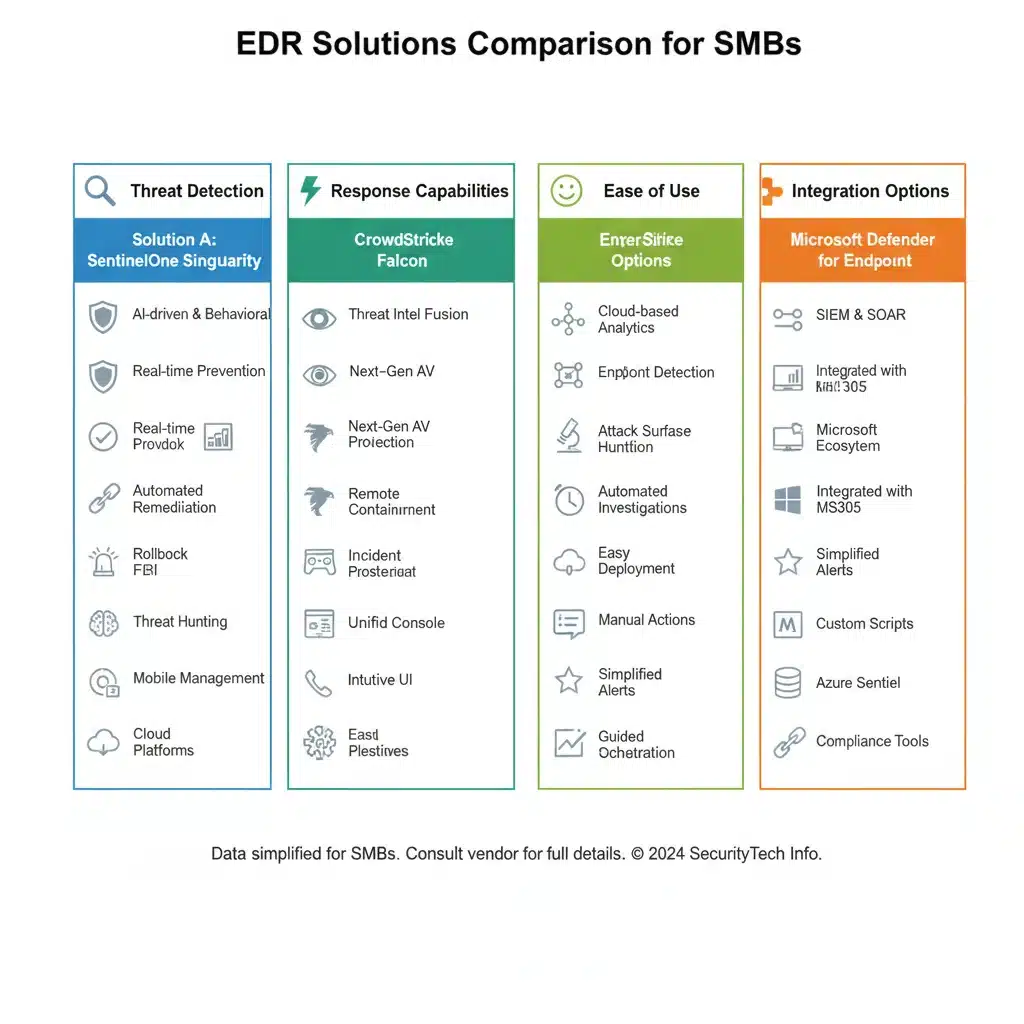
CrowdStrike consistently ranks as a top performer in industry evaluations, known for its exceptional detection rates and ability to stop advanced threats. The Falcon UI is generally considered user-friendly, offering clear dashboards and detailed insights into security incidents. While the breadth of features can be extensive, the modular nature allows SMBs to start with core EDR and expand as needed.
Pricing and Value for SMBs
CrowdStrike offers various modules and subscription tiers, allowing SMBs to tailor their security investment. While it can be perceived as a higher-end solution, the comprehensive protection, advanced threat intelligence, and optional managed services provide significant value, especially for SMBs with a higher risk profile or those handling sensitive data. Its efficacy in preventing breaches often justifies the investment.
Top EDR Solution 3: Microsoft Defender for Business
Overview and Core Strengths
For SMBs already entrenched in the Microsoft ecosystem, Microsoft Defender for Business emerges as a highly compelling EDR solution. It’s specifically designed for organizations with up to 300 users, bringing enterprise-grade endpoint security capabilities from Microsoft Defender for Endpoint to a more accessible and simplified package. Its seamless integration with other Microsoft 365 services is a major advantage.
Key Features for SMBs
- Simplified Management: Defender for Business offers a streamlined management experience tailored for SMBs, making it easier to deploy, configure, and monitor security across devices.
- Enterprise-Grade Security: It includes robust next-generation antivirus, endpoint detection and response (EDR), automated investigation and remediation, and threat & vulnerability management.
- Automated Investigation and Remediation: This feature automatically investigates alerts and remediates complex threats, reducing the manual workload for IT teams.
- Threat & Vulnerability Management: Helps SMBs discover, prioritize, and remediate software vulnerabilities and misconfigurations across their Windows and macOS devices.
- Integration with Microsoft 365: For businesses already using Microsoft 365, Defender for Business offers unparalleled integration, providing a unified security experience across email, identity, and endpoints.
- Cross-Platform Support: Protects Windows, macOS, Android, and iOS devices, ensuring comprehensive coverage for modern SMB environments.
- Security Configuration Management: Allows for easy deployment of security policies and settings across all managed devices.
Performance and Usability
Microsoft Defender components consistently score well in independent tests for detection and prevention. Defender for Business is designed with an intuitive interface that integrates directly into the Microsoft 365 admin center, making it familiar for existing Microsoft users. Its automation capabilities help to simplify security operations, which is a major benefit for SMBs.
Pricing and Value for SMBs
Microsoft Defender for Business is often included as part of specific Microsoft 365 Business Premium subscriptions, providing immense value for SMBs already paying for these suites. This bundled approach makes it an extremely cost-effective option, delivering powerful EDR capabilities without a separate, significant investment. For businesses heavily invested in Microsoft products, it offers the best seamless experience and a strong security posture at a competitive price point.
Comparative Analysis: SentinelOne vs. CrowdStrike vs. Microsoft Defender for Business
To further assist SMBs in their decision-making process, let’s directly compare these three leading EDR solutions across key dimensions:
Detection & Prevention Capabilities
- SentinelOne: Excels with autonomous AI that operates effectively even offline, providing robust protection against zero-days and fileless attacks with automated remediation.
- CrowdStrike: Renowned for its unparalleled threat intelligence and proactive threat hunting (OverWatch), leveraging a vast cloud-based graph to detect highly sophisticated and stealthy attacks.
- Microsoft Defender for Business: Offers strong, enterprise-grade detection and prevention leveraging Microsoft’s extensive threat intelligence, with a focus on automated investigation and remediation suitable for SMBs.
Ease of Management & Deployment
- SentinelOne: Highly automated, reducing the need for constant IT intervention. Cloud-native and straightforward to deploy.
- CrowdStrike: Lightweight agent and cloud-native architecture ensure easy deployment. Management console is powerful but can have a learning curve for some SMBs initially.
- Microsoft Defender for Business: Designed for simplified management within the Microsoft 365 ecosystem, making it exceptionally easy for existing Microsoft users to deploy and manage.
Cost-Effectiveness for SMBs
- SentinelOne: Offers strong value through automation, potentially reducing operational costs. Pricing is competitive, with tiered options.
- CrowdStrike: Can be a higher investment but justifies it with industry-leading threat intelligence and proactive hunting. Modular pricing allows for customization.
- Microsoft Defender for Business: Often the most cost-effective for Microsoft 365 Business Premium subscribers, as it’s included in the bundle, offering significant security features without additional per-seat costs.
Integration and Ecosystem
- SentinelOne: Offers strong API integrations and partnerships, allowing it to fit into various security stacks.
- CrowdStrike: Provides a broad ecosystem of integrations and a robust API for extending capabilities.
- Microsoft Defender for Business: Unmatched integration with the Microsoft 365 suite, providing a cohesive security posture across identity, email, and endpoints.
Suitability for SMBs
- SentinelOne: Ideal for SMBs seeking powerful, autonomous protection with minimal IT oversight. Its storyline technology helps simplify incident response.
- CrowdStrike: Best for SMBs that prioritize cutting-edge threat intelligence, proactive hunting, and are willing to invest in top-tier security, potentially leveraging their MDR services.
- Microsoft Defender for Business: An excellent choice for SMBs already invested in Microsoft 365, looking for integrated, simplified, and cost-effective enterprise-grade EDR.
Implementing EDR Solutions in Your SMB: Best Practices
Once you’ve chosen the best EDR solution for your business, successful implementation is paramount. Here are some best practices for SMBs:
- Phased Rollout: Don’t deploy to all endpoints at once. Start with a pilot group to identify and resolve any compatibility issues or unexpected behaviors.
- Integrate with Existing Security: Ensure your EDR solution works harmoniously with your firewall, identity management, and other security tools.
- Educate Your Team: While EDR automates much of the work, your IT team (even if small) should understand how to use the dashboard, interpret alerts, and initiate basic responses.
- Define Incident Response Plan: An EDR solution is only as good as the response plan it supports. Clearly define who is responsible for what actions when an alert is triggered.
- Regular Review and Tuning: Security is not a set-it-and-forget-it task. Regularly review EDR reports, adjust policies, and fine-tune settings to optimize performance and reduce false positives.
- Consider Managed Services: If your SMB lacks dedicated security personnel, consider leveraging Managed EDR (MEDR) or Managed Security Service Providers (MSSPs) that specialize in EDR to handle monitoring and response. This can provide 24/7 expert coverage without the overhead of an in-house SOC.
- Stay Updated: Ensure your EDR agent and cloud components are always up-to-date to benefit from the latest threat intelligence and security enhancements.
The Future of EDR for SMBs in 2026 and Beyond
The EDR landscape for SMBs is continuously evolving. In 2026 and beyond, we can expect to see further advancements tailored to smaller organizations:
- Increased Automation and AI: Even more sophisticated AI and machine learning will further reduce the need for human intervention, making EDR more accessible and effective for resource-constrained SMBs.
- XDR (Extended Detection and Response) Convergence: EDR will increasingly integrate with other security layers (network, cloud, identity, email) to provide a more holistic view of threats, moving towards XDR. SMB-focused XDR solutions will simplify security operations across multiple domains.
- Emphasis on Proactive Posture Management: EDR solutions will place greater emphasis on continuous vulnerability management, security hygiene, and proactive risk assessment to prevent attacks before they start.
- Simplified Compliance: EDR tools will offer more streamlined reporting and features to help SMBs meet various industry and regulatory compliance requirements.
- Enhanced User Experience: User interfaces will become even more intuitive, providing clearer visualizations and actionable intelligence for non-specialist IT staff.
These trends highlight a future where advanced cybersecurity becomes more attainable and manageable for SMBs, enabling them to defend against increasingly sophisticated threats with greater efficiency.
Conclusion: Securing Your SMB with the Right EDR Solution
The decision of which EDR solution to adopt in 2026 is a critical one for any small to medium US business. The threats are real, pervasive, and constantly evolving. Investing in a robust EDR system is no longer a luxury but a fundamental component of a resilient cybersecurity strategy.
SentinelOne, CrowdStrike, and Microsoft Defender for Business each offer compelling advantages for SMBs, catering to different priorities and existing IT ecosystems. SentinelOne stands out for its autonomous AI and ease of automated remediation, ideal for businesses seeking powerful protection with minimal hands-on management. CrowdStrike offers industry-leading threat intelligence and proactive hunting, perfect for SMBs that demand the highest level of threat detection and are willing to invest in it. Microsoft Defender for Business provides exceptional value and seamless integration for SMBs already leveraging the Microsoft 365 suite, offering enterprise-grade security in a simplified package.
Ultimately, the best EDR solution for your SMB will depend on your specific needs, budget, existing infrastructure, and the level of in-house IT expertise. We encourage you to evaluate each of these top contenders against your unique requirements, perhaps even requesting demos or trials, to ensure you select an EDR solution that will effectively safeguard your business against the cybersecurity challenges of 2026 and beyond. Proactive security is the best defense, and with the right EDR in place, your SMB can thrive securely in the digital age.