Zero Trust Architecture: Reduce Cyber Breach Risk by 70% in 12 Months

In today’s interconnected digital landscape, the question is no longer if your organization will face a cyberattack, but when. Traditional perimeter-based security models, once the bedrock of enterprise defense, are proving increasingly insufficient against sophisticated and persistent threats. The adage ‘trust but verify’ has been replaced by a more stringent, pragmatic approach: ‘never trust, always verify.’ This fundamental shift underpins the philosophy of Zero Trust Architecture, a strategic imperative for any organization serious about safeguarding its digital assets.
The promise of Zero Trust Architecture is not merely incremental improvement; it’s a transformative leap in cybersecurity posture. Industry experts and early adopters consistently report dramatic reductions in breach risk, often citing figures as high as 70% within a year of diligent implementation. This isn’t theoretical; it’s a measurable, tangible outcome that redefines security efficacy. This comprehensive guide delves into the ‘how’ and ‘why’ of implementing Zero Trust Architecture, providing a roadmap to achieve significant risk reduction and build a truly resilient cyber defense.
We will explore the foundational principles, key components, and a phased approach to integrate Zero Trust Architecture into your existing infrastructure. From identity and access management to microsegmentation and continuous monitoring, each element plays a critical role in weaving a robust fabric of security that assumes compromise and limits its impact. Prepare to gain the insider knowledge necessary to embark on this crucial journey, protecting your organization from the ever-evolving threat landscape.
Understanding the Paradigm Shift: Why Traditional Security Fails and Zero Trust Succeeds
For decades, enterprise security relied on a castle-and-moat approach. Strong defenses were built around the perimeter, assuming that everything inside the network was trustworthy. This model worked reasonably well when applications and data resided primarily within on-premises data centers, and user access was largely confined to corporate networks. However, the modern enterprise has shattered these boundaries. Cloud computing, mobile workforces, IoT devices, and complex supply chains mean the ‘perimeter’ is now everywhere and nowhere simultaneously.
The inherent flaw in the traditional model is its implicit trust. Once an attacker breaches the perimeter, they gain a significant advantage, often moving laterally through the network undetected, escalating privileges, and exfiltrating data. This lateral movement is precisely what Zero Trust Architecture aims to prevent. Instead of assuming trustworthiness, Zero Trust mandates verification for every access request, regardless of where it originates or what resource it seeks to access. It operates on the principle that no user, device, or application should be inherently trusted, even if they are already inside the network.
The Core Tenets of Zero Trust Architecture
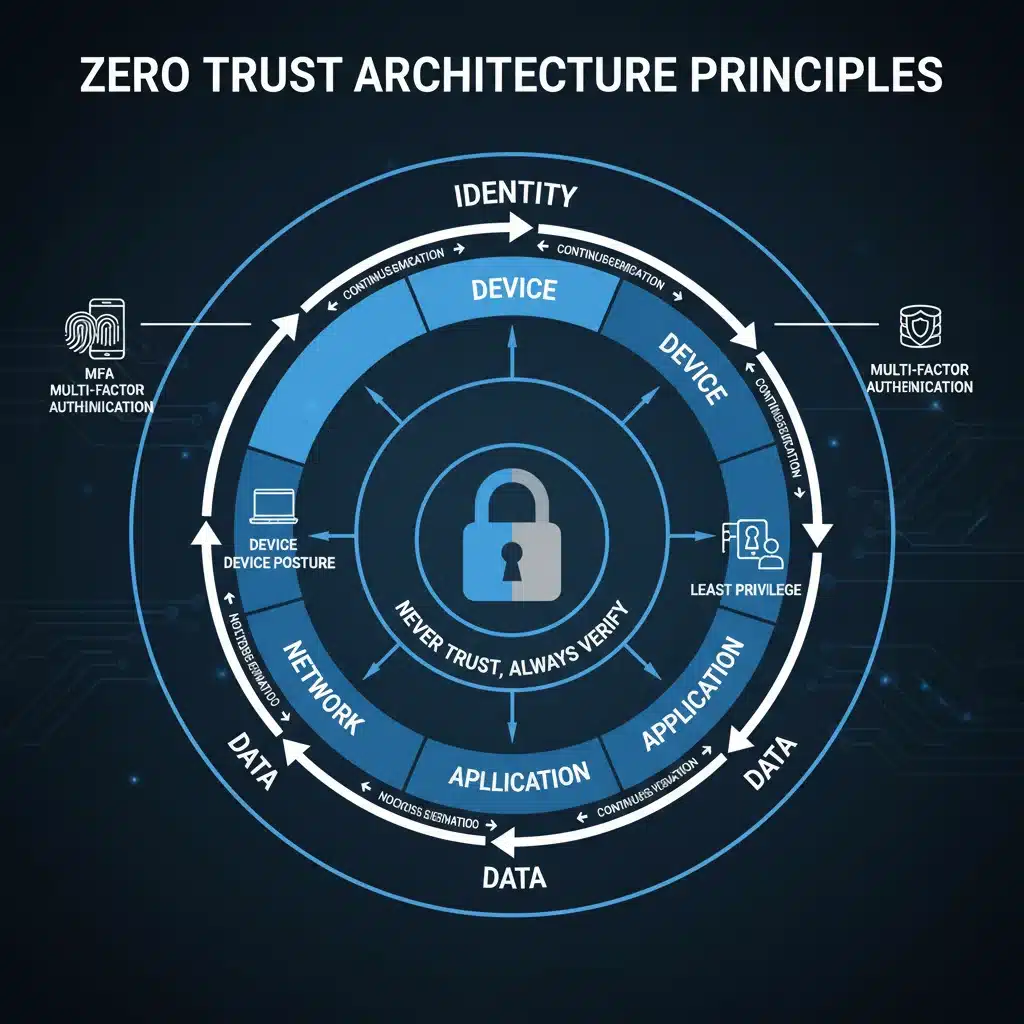
At its heart, Zero Trust Architecture is built upon several immutable principles that guide its implementation and operational philosophy:
- Never Trust, Always Verify: This is the cornerstone. Every access request, from any entity to any resource, must be authenticated, authorized, and continuously validated.
- Least Privilege Access: Users and devices are granted only the minimum necessary access to perform their designated tasks. This minimizes the potential impact of a compromised account or device.
- Assume Breach: Organizations must operate under the assumption that their network has already been compromised. This mindset drives proactive security measures and rapid response capabilities.
- Microsegmentation: The network is divided into small, isolated segments, limiting lateral movement for attackers and containing breaches to specific areas.
- Multi-Factor Authentication (MFA) Everywhere: Strong authentication is mandatory for all access, significantly reducing the risk of credential-based attacks.
- Continuous Monitoring and Validation: Security posture is not a one-time check but an ongoing process. All access, user behavior, and device health are continuously monitored for anomalies and potential threats.
By adopting these tenets, organizations move away from a reactive, perimeter-focused defense to a proactive, identity- and data-centric security model. This fundamental shift is what empowers organizations to achieve a 70% reduction in breach risk, as it systematically eliminates the pathways attackers exploit in traditional environments.
The Business Case for Zero Trust: Beyond Just Security
While enhanced security is the primary driver for adopting Zero Trust Architecture, the benefits extend far beyond simply preventing breaches. A well-implemented Zero Trust strategy can deliver significant business advantages, making it a strategic investment rather than just a cost center.
Reduced Financial Impact of Breaches
Data breaches are incredibly costly. Beyond regulatory fines and legal fees, organizations face reputational damage, customer churn, intellectual property loss, and significant downtime. By reducing the likelihood and impact of breaches by up to 70%, Zero Trust Architecture directly translates to substantial financial savings and protects the long-term viability of the business.
Improved Compliance and Regulatory Adherence
Many regulatory frameworks (e.g., GDPR, HIPAA, PCI DSS, CCPA, NIST) mandate stringent data protection and access control measures. Zero Trust principles align perfectly with these requirements, making it easier for organizations to demonstrate compliance and avoid penalties. The granular control and extensive logging capabilities inherent in Zero Trust provide a clear audit trail for regulators.
Enhanced Operational Efficiency and Agility
Paradoxically, a more secure environment can also be more efficient. By automating access decisions, streamlining identity management, and providing consistent security across diverse environments (on-premises, cloud, hybrid), Zero Trust can reduce the administrative burden on IT and security teams. It also enables organizations to adopt new technologies and business models (like remote work or multi-cloud strategies) with greater confidence and speed, knowing that security is baked in, not bolted on.
Better User Experience
While it might sound counterintuitive, Zero Trust can improve the user experience. By implementing single sign-on (SSO) and intelligent access policies that adapt to context (e.g., location, device health), users can gain secure access to resources more seamlessly, without constant password prompts or cumbersome VPN connections. The focus shifts from frustrating security roadblocks to intelligent, adaptive access.
Strengthened Resilience Against Advanced Threats
Modern cyber threats, such as ransomware, supply chain attacks, and advanced persistent threats (APTs), are designed to circumvent traditional defenses. Zero Trust Architecture, with its emphasis on microsegmentation, continuous verification, and least privilege, is inherently better equipped to detect and contain these threats, limiting their blast radius and enabling faster recovery.
The Foundational Pillars of a Successful Zero Trust Implementation
Implementing Zero Trust Architecture is not a one-time project but a continuous journey involving several interconnected pillars. Understanding these foundational elements is crucial for a successful rollout and achieving that significant reduction in breach risk.
1. Identity and Access Management (IAM) as the New Perimeter
In a Zero Trust model, identity becomes the primary control plane. Strong IAM is paramount, encompassing:
- Multi-Factor Authentication (MFA): Non-negotiable for all users accessing any resource. This is the single most effective control against credential theft.
- Single Sign-On (SSO): Improves user experience and centralizes authentication, making it easier to enforce policies.
- Privileged Access Management (PAM): Strict controls over accounts with elevated permissions, often involving just-in-time access and session monitoring.
- Identity Governance and Administration (IGA): Ensuring that users have the right access at the right time, and that access is revoked when no longer needed.
- Behavioral Analytics: Monitoring user and entity behavior (UEBA) to detect anomalous activities that might indicate a compromised account.
2. Device Security and Endpoint Protection
Every device attempting to access corporate resources—laptops, smartphones, IoT devices—must be known, healthy, and compliant with security policies. This involves:
- Endpoint Detection and Response (EDR)/Extended Detection and Response (XDR): Continuous monitoring of endpoint activity for malicious behavior.
- Device Posture Checks: Verifying device health, patch levels, configuration, and compliance with security policies before granting access.
- Mobile Device Management (MDM)/Unified Endpoint Management (UEM): Securing and managing mobile devices accessing corporate data.
3. Microsegmentation and Network Security
This pillar is about preventing lateral movement. Instead of a flat network, microsegmentation divides the network into granular security zones, with policies dictating communication between them. Key aspects include:
- Software-Defined Networking (SDN) and Network Virtualization: Technologies that enable dynamic creation and enforcement of microsegments.
- Next-Generation Firewalls (NGFWs): Applying granular firewall policies at the workload level, not just the perimeter.
- Zero Trust Network Access (ZTNA): Replacing traditional VPNs, ZTNA provides secure, context-aware access to specific applications, rather than full network access.
4. Data Security and Governance
Ultimately, Zero Trust is about protecting data. This pillar focuses on classifying data, encrypting it, and enforcing policies around its usage and storage:
- Data Classification: Understanding what data you have, where it resides, and its sensitivity.
- Data Loss Prevention (DLP): Preventing sensitive data from leaving the organization’s control.
- Encryption: Encrypting data at rest and in transit.
- Cloud Security Posture Management (CSPM) and Cloud Workload Protection Platforms (CWPP): Securing data and workloads in cloud environments.
5. Application Security
Applications are often the gateways to data. Securing them is vital:
- API Security: Protecting application programming interfaces (APIs) from unauthorized access and attacks.
- Web Application Firewalls (WAFs): Defending web applications against common web-based attacks.
- Secure Software Development Life Cycle (SSDLC): Integrating security into every stage of application development.
6. Visibility, Analytics, and Automation
Continuous monitoring and rapid response are critical. This pillar involves:
- Security Information and Event Management (SIEM)/Security Orchestration, Automation, and Response (SOAR): Centralized logging, threat detection, and automated response capabilities.
- Threat Intelligence: Leveraging external threat data to proactively identify and mitigate risks.
- Behavioral Analytics: Detecting deviations from normal user and system behavior.
A 12-Month Roadmap to 70% Breach Risk Reduction with Zero Trust Architecture
Achieving a 70% reduction in cyber breach risk within 12 months with Zero Trust Architecture is an ambitious but attainable goal. It requires a structured, phased approach, executive buy-in, and a commitment to continuous improvement. Here’s a possible roadmap:
Phase 1: Assessment and Planning (Months 1-2)
Goal: Understand current state, define scope, and secure executive sponsorship.
- Current State Assessment: Map your existing IT environment, including users, devices, applications, data, and network architecture. Identify critical assets and potential attack vectors.
- Risk Assessment: Pinpoint the highest-risk areas where Zero Trust can have the most immediate impact.
- Define Scope and Prioritization: Start small. Identify a pilot project or a specific, high-value application/data set to apply Zero Trust principles first. This allows for learning and refinement.
- Build the Business Case: Quantify the potential benefits (risk reduction, compliance, efficiency) and present to leadership. Secure necessary budget and resources.
- Form a Cross-Functional Team: Include representatives from IT, security, operations, development, and business units.
- Choose a Zero Trust Framework: Align with established frameworks like NIST SP 800-207 for guidance.
Phase 2: Identity and Access Management (IAM) Overhaul (Months 3-5)
Goal: Establish strong identity as the new control plane.
- Implement/Enhance MFA: Roll out MFA for all users, starting with privileged accounts and then extending to all employees and contractors.
- Centralize Identity Provider (IdP): Consolidate user identities into a single, authoritative source (e.g., Azure AD, Okta, Ping Identity).
- Implement SSO: Integrate critical applications with your IdP for seamless and secure access.
- Begin PAM Implementation: Identify and secure privileged accounts, implementing just-in-time access where feasible.
- Develop Access Policies: Define granular access policies based on user role, device posture, location, and other contextual attributes.
Phase 3: Device Security and Microsegmentation (Months 6-9)
Goal: Secure endpoints and limit lateral movement.
- Enhance Endpoint Security: Deploy or optimize EDR/XDR solutions across all endpoints.
- Implement Device Posture Checks: Integrate device health and compliance into access decisions. Ensure only healthy, compliant devices can access resources.
- Pilot Microsegmentation: Apply microsegmentation to your chosen pilot project or critical asset. Isolate specific applications, databases, or sensitive data stores.
- Implement ZTNA for Remote Access: Replace traditional VPNs with ZTNA for remote workers, providing secure, application-specific access.
- Network Visibility: Deploy tools to gain deep visibility into network traffic and dependencies between workloads.
Phase 4: Data, Application Security, and Automation (Months 10-12)
Goal: Protect data at its core, secure applications, and automate operations.
- Data Classification and DLP: Implement data classification tools and DLP policies to protect sensitive information.
- Application Security Review: Conduct security assessments of critical applications and implement WAFs or API gateways where necessary.
- Expand Microsegmentation: Roll out microsegmentation to additional segments of your network based on lessons learned from the pilot.
- Integrate SIEM/SOAR: Centralize security logging, enable threat detection rules, and begin automating responses to common incidents.
- Continuous Monitoring & Analytics: Establish baselines for normal behavior and continuously monitor for deviations. Leverage UEBA for advanced threat detection.
- Refine Policies: Continuously review and refine access policies based on operational feedback and new threat intelligence.
Challenges and Considerations in Zero Trust Implementation
While the benefits of Zero Trust Architecture are clear, the journey is not without its challenges. Being aware of these hurdles upfront can help organizations plan more effectively.
Complexity of Existing Infrastructure
Many organizations have legacy systems, complex network topologies, and a mix of on-premises and cloud environments. Integrating Zero Trust principles into this heterogeneous landscape can be challenging and requires careful planning and potentially significant architectural changes.
Organizational Buy-in and Culture Change
Zero Trust impacts everyone, from end-users to IT administrators. It requires a shift in mindset from implicit trust to explicit verification. Gaining buy-in from all stakeholders and managing the cultural change is as important as the technical implementation.
Resource Constraints
Implementing Zero Trust requires investment in new technologies, staff training, and dedicated personnel. Budgetary and skill-set constraints can slow down or derail implementation efforts. Organizations may need to consider external expertise or managed security services.
Policy Management and Granularity
Defining and managing granular access policies for every user, device, and resource can become complex. Overly restrictive policies can impede productivity, while overly permissive ones defeat the purpose of Zero Trust. Striking the right balance is crucial.
Vendor Sprawl and Integration
A comprehensive Zero Trust strategy often involves multiple security tools from different vendors. Ensuring seamless integration and interoperability between these tools is essential to avoid security gaps and operational overhead.
Continuous Monitoring and Adaptation
Zero Trust is not a ‘set it and forget it’ solution. The threat landscape evolves, business requirements change, and new technologies emerge. Organizations must commit to continuous monitoring, policy refinement, and adaptation to maintain an effective Zero Trust posture.
Measuring Success: Quantifying the 70% Reduction
How do you quantify a 70% reduction in breach risk? This requires establishing clear metrics and a robust measurement framework. Key performance indicators (KPIs) and metrics to track include:
- Mean Time to Detect (MTTD) and Mean Time to Respond (MTTR): Significant reductions in these metrics indicate improved threat detection and incident response capabilities, directly lowering breach impact.
- Number of Unauthorized Access Attempts Blocked: A direct measure of the effectiveness of IAM and access policies.
- Reduction in Lateral Movement Incidents: Track attempts by attackers to move within the network post-initial compromise, indicating the effectiveness of microsegmentation.
- Compliance Audit Scores: Improved scores in internal and external audits demonstrate better adherence to security standards.
- Security Posture Score: Utilize industry benchmarks or security rating services to track overall security improvements over time.
- Number of Vulnerabilities Exploited: A decrease in successful exploits points to stronger overall security.
- User Feedback and Productivity: Ensure that security enhancements do not unduly hinder legitimate user activity.
Regular reporting on these metrics to leadership and stakeholders demonstrates the tangible value of your Zero Trust Architecture investment and reinforces the ongoing commitment to cybersecurity excellence.
Conclusion: Embracing Zero Trust for a Secure Future
The journey to implement Zero Trust Architecture is comprehensive, requiring strategic planning, technological investment, and a cultural shift. However, the rewards—a projected 70% reduction in cyber breach risk within 12 months, enhanced compliance, and improved operational agility—make it an indispensable endeavor for any organization navigating the complexities of the modern digital world.
By adopting the ‘never trust, always verify’ mantra, organizations can build a resilient defense that withstands even the most sophisticated cyber threats. It’s about moving beyond perimeter-centric thinking and embracing an identity- and data-centric approach that secures every access, every device, and every interaction. The time for proactive, adaptive security is now. Embrace Zero Trust Architecture, and fortify your organization against the inevitable challenges of the cyber landscape, securing your future in the process.